Showing posts with label african aviation. Show all posts

Tunisia: Syphax Airlines to launch flights in March

 According to information received from the authorities in the Tunisian Ministry of Transport, the country's newest airline, Syphax Airlines, will launch flights in mid-March, operating from Sfax-Thyna International Airport in Eastern Tunisia.


The transport ministry is currently studying the modalities for allowing the private airline to operate from the airport. Syphax Airlines will operate two aircraft, Airbus A319, to provide regular and charter flights to European and Arab countries.


Syphax Airlines

In January 2012, Syphax Airlines announced the signing of an agreement of $55million for the acquisition of two Airbus A319 aircraft, each with a capacity of 150 passengers. Recently, Tunisia's Telnet Holdings invested in the new airline venture.

The company said that delivery of the first plane to the International Sfax Thyna airport will be made on February 29, 2012 and the second delivery on March 14, 2012.

The two aircraft will provide eight daily flights  from the
Sfax-Thyna International Airport  to Tripoli (Libya), Morocco, France, Italy, Belgium and Turkey.
 

The establishment of Syphax Airlines brings to five the number of Tunisian airlines. The others include Tunisair (publicly-held), Nouvelair, Tunisair Express and Tunisavia.

Email Us at FlightAfricablog@gmail.com

DR Congo Suspends two airlines after Gulfstream IV N2SA Crash

 The government of the Democratic Republic of Congo has suspended the licenses of two aviation companies operating in the country after one of their planes crashed last week killing a top adviser to President Kabila and four others.

 Minister of Transport Joseph Martin Kitumba said in a statement released late Tuesday that the licenses of Air Katanga Express and Katanga Wings had been suspended as Congolese and American experts investigate the crash of the Gulfstream 3 jet.
The Gulfstream IV crash in Bukavu
 The Katanga Express plane went down Sunday as it attempted to land at Bukavu airport in eastern Congo. Among the five bodies pulled out of the wreck was Augustin Katumba Mwanke, described in United States diplomatic cables as "the power behind the throne" in Kabila's administration, according to WikiLeaks.

The plane's two pilots were also killed. There were 10 passengers on board.

The minister announced that a special commission will investigate the causes of the crash. Congo has one of the worst safety records in the world. Just two weeks ago, an Antonov plane crashed after it left the same airport in eastern Congo. Officials found the debris from the destroyed plane around 6 miles (10 kilometers) from the town of Namoya, where it was supposed to land an hour later.

Last July a plane operated by a different airline crashed, killing 85 people on board. The forested country has almost no good roads outside of the capital, forcing people to rely on badly-maintained flights or boats.

Each time, Congolese officials have promised an investigation. The death of the presidential adviser, who on Wednesday was posthumously awarded an honor, may finally prompt a more-in depth review. In addition to Mwanke, who was also the former governor of copper-rich Katanga province, the minister of finance, a provincial governor and one of Kabila's at-large ambassadors were also injured. The three were evacuated to South Africa for treatment.

"Given the urgency and the necessity, an investigative commission has been created and charged with leading an investigation into the probable cause of the accident, and determining responsibility," said the statement.

Congo expert Jason Stearns wrote on his blog that Mwanke's influence cannot be overstated. He had a direct hand in the country's mining contracts.

"He was the mastermind behind crucial financial deals, including most of the big mining deals concluded in the past decade. ... 'No mining contract is signed without Katumba's approval,' is a phrase I heard more than once among Kinshasa businessmen," wrote Stearns, author of a history of Congo's conflict. "Rasputin, Dick Cheney, eminence grise -- these were all epithets applied to Katumba." 

Email Us at FlightAfricablog@gmail.com

Indian Airlines staff not paid for two months!

Indian Airlines are seeing red!
Indian airlines have been faced by an unprecedented financial woes since last year and some have been unable to pay their staff since November last year! Some 18,000 staff of two major Indian airlines have not been paid since November 2011, according to  report from India's The Economic Times.
On Monday this week, Kingfisher Airlines delayed payments for the umpteenth time for its December salaries citing "large unanticipated payments" issued by their airline to creditors.  Employees of Jet Airways, India's largest private carrier, have not been paid their January salaries.
KIngfisher Airlines Crew: Working without pay

Kingfisher Airlines CEO Sanjay Aggarwal in an email to employees informed them of the new delays in the issue of salaries "We got hit by a couple of large unanticipated payments which had to be addressed on an emergency basis," Kingfisher last paid employees in November last year. About 180 Kingfisher pilots, out of the airline's 700, have written to the management warning that they may not report duty if their December salaries are not paid soon.

Stiff competition in the market, rising fuel costs and low fares means Indian Airlines have posted a loss of $1 billion in the current financial year. Boeing has urged the cash-strapped carriers to increase fares by 15% to break even but with the brutal competition on the Indian aviation market, this is not even an option!

But the Indian airlines crew still report to work, hoping for the best. Staff from African airlines are quite lucky that their airlines are churning out a profit, they get paid on time, and still demand more salary increases!

Read Full story on the Economic Times

Email Us at FlightAfricablog@gmail.com

AviaAssist Foundations Calls for Nomination for the African Aviator Award

The London-based AviAssist Foundation has called for nominations for the African Aviator Award, a statement said on Saturday.

The statement stated that the prestigious African Aviator Award was aimed at rewarding safety champions and promote entry of Africans in the aviation industry.

African Aviator Award to Promote Entry of Africans into the Aviation Industry
It will include a trip to the awarding event, US$500 in cash and a hand-lettered citation.
"Everyday, thousands of professionals in Africa contribute to making commercial aviation the safest form of transportation,"the statement said.

"They do so not because they expect special recognition. They think safety and act in ways that promote safety because they know the aviation industry depends on it, and because it is the right thing to do."

It said aggregate data for the entire continent masks the gains from their professionalism and the role of safety champions among them.

The statement said that AviAssist Foundation could not salute all these men and women individually, "although it pays tribute to them through its work".

"From 2012 onwards, the AviAssist Foundation will single out individuals or teams that have made especially outstanding contributions to risk reduction, often during long periods or entire careers and award the African Aviator Award," AviAssist Director Tom Kok, said.

He disclosed that each year, the AviAssist Foundation will select a particular aviation profession as the focus for the award.

For 2012, the selected profession for the award is Air Traffic Management/Control in its widest sense, with the award being offered in co-operation with the Civil Air Navigation Services Organisation (CANSO), Kok stated.

The recipient of this prestigious international award will be selected by an independent selection board from among candidates nominated by aviation professionals and organizations worldwide.
The winner of the 2012 award will be selected from the nominations.

The deadline for nominations for the African Aviator award is September 1, 2012.

The award will be presented during an award dinner and awards ceremony at the 2012 CANSO Global ATM Safety Conference in Cape Town, South Africa on 29 October-2 November, in front of an audience of industry leaders and colleagues.

The 2012 award was instituted by the AviAssist Foundation in co-operation with the Civil Air Navigation Services Organisation CANSO with sponsoring from among others CANSO, ATNS South Africa and KLM Airlines 


Read More on African Aviator Award
Email Us at FlightAfricablog@gmail.com

Why the Airlines are Bankrupt (INFOGRAPHIC)

FrugalDad.com has put up an awesome Infographic on why airlines charge high fees for their services and at the end of the year, make very large losses. Yet another reason to invest your money elsewhere, but at least in Africa, aviation is booming, so some airlines in this region will continue making marginal profits.

A throw back to the years before 1978, American aviation was highly regulated including fares, schedules and routes. The only American airline that could fly international was PanAm and airlines then had to compete purely on services. With the deregulation came in new players and competitors and many airlines soon went under or filed for bankruptcy.

Airlines are also losing cash, lots of it, through Online Travel Agencies like Priceline, Orbitz, Expedia, Opodo. American Airlines alone paid 4% of their operating expenses to OTAs or an estimated $976million in 2010. Learn more on why your favorite airline filed for bankruptcy below:

flight
Source: http://frugaldad.com

Email Us at FlightAfricablog@gmail.com

Kenya Police Air Wing first African customer of Eurocopter’s AS350B3e

The Kenya Police Air Wing has become the first African customer to receive Eurocopter’s AS350B3e Ecureuil helicopter, which features an uprated power plant for better overall performance aimed at expanding the force's airborne law enforcement and crime prevention unit.

The aircraft is dedicated to police law enforcement and crime prevention missions including anti-poaching, anti-terrorism operations. It will also be deployed in search & rescue, casualty evacuation, personnel transport and various other civic protection roles.
EuroCopter's AS350B3e
The Kenya Police Air-Wing is the first African customer for the AS350 B3e, which features an uprated Turbomeca Arriel 2D turbine engine allowing better takeoff performance.

Range and payload was a primary consideration in selecting the AS350 B3e as the Air-Wing required a helicopter capable of patrolling both the dense built up area around the major cities, Nairobi and Mombasa, but also to cover smaller towns and communities spread over large areas. Kenya has a land area of 580 000 square kilometres and a population of nearly 39 million residents. It has a diverse geography including a long Indian Ocean coastline. Inland, the terrain varies from savannah grasslands to forests, mountains and even dessert regions.

The AS350 has also been ordered by law enforcement agencies in Angola, Namibia, Botswana and South Africa. Some 5 000 Ecureuil helicopters have been delivered in 98 countries for some 1 600 operators. These aircraft have cumulated more than 21 million flight hours.

The AS350 was assembled by Eurocopter’s subsidiary Eurocopter Southern Africa at Grand Central airport, South Africa, and ferried to Kenya in early December. Eurocopter Southern Africa won the Kenyan order after a competitive tender.

Established in 1994, the subsidiary employs 80 people to generate an annual turnover of over R300 million through the sale of helicopters and the maintenance of approximately 250 in the region. Able to provide technical as well as pilot training, Eurocopter Southern Africa is currently deploying a full flight Super Puma simulator in Johannesburg to offer basic and advanced simulator training to its African customers’ base.


Email Us at FlightAfricablog@gmail.com

African Airlines Association Opposes European Emissions Trading System(ETS)

As predicted by former IATA chief Giovanni Bisignani, it seems Europe's stubborn, unilateral inclusion of foreign airlines into its Emissions Trading System will fail eventually or worse still, spark a trade war. The EU ETS naturally creates a trade imbalance as other countries are not imposing carbon taxes on EU airlines. AFRAA has now joined the EU and China to oppose the the EU ETS, perhaps this crisis can force governments to work harder on the ICAO process to come up with harmonized global framework that does not leave people behind. Europe's unilateral move will however draw significant push back from world powers and at the end, it's the passengers who will pay the highest price. If the airlines' lobbying will not get the EU and other governments to behave, then they will simply pass on the costs to travelers.


Under EU Emissions Trading System,  EU and foreign airlines will purchase carbon credits in the EU to offset their greenhouse emissions in the region. Initially covering power stations, combustion plants, oil refineries and iron and steel works, as well as factories making cement, glass, lime, bricks, ceramics, pulp, paper and board. Aviation was later included.
Although several key African airlines have complied with the EU Emission Trading Scheme, and at a very substantial cost, the African Airlines Association (AFRAA) has now taken up the matter once again with a public statement issued from the association’s office in Nairobi, opposing the launch of it and demanding wider consultations between the European Union and affected countries around the world.


This happened after Chinese airlines have vowed not to comply and American airlines have taken the matter to court, paving the way for a potentially crippling trade war between the EU on one side and America and Far Eastern countries on the other side of the divide, with independent analysts and observers estimating that the damage to Europe’s trading position in the world could take a serious hit.

The uncompromising stand by the EU Commission, now also hiding behind a ruling by the European Court, that they have the right to impose such unilateral schemes, had also not helped as the wisdom of the move continues to be challenged from around the world.

There is, in particular, emerging talk of "punishing" the EU as a trade block by increasing trade between the opponents of the scheme and, in particular, sidelining European attempts to get rich mineral and mining concessions in Africa by giving access to such resources to North American and Asian competitors.

Said a regular source from Nairobi a few days ago: "… so, of course, we have to comply, because otherwise we can risk huge fines or even have an aircraft detained. But we support the initiative of AFRAA and have for a while said the EU should engage in further talks and not slap the rest of the world with unilateral taxes."
At the same time, the EU’s aviation black list has also come under fire and scrutiny again, as, in particular, African airlines have been banned from the EU’s air space. Here, the same source said; "… but, of course, we are aware of safety issues in countries like Sudan or Congo, which have the worst record in Africa, if not the world. But then look at Russia, they had lots of crashes, too, and there is no blanket ban for them like we Africans are suffering. But then Russia has muscle, has influence, has oil and gas, and the EU will not dare treat them in such an openly contemptuous manner as they treat us.

"As aviators, we all agree with the need to improve safe operations, adhere to maintenance requirements and train crews in line with international ICAO standards, but we often feel the EU has a hidden agenda and no amount of denials has changed that, in fact, some of their denials read like a confirmation of our suspicions."

Additional information from eTurbo News
Email Us at FlightAfricablog@gmail.com

The Rise of African Aviation

A recent piece argues that despite lacklustre safety records and incomplete liberalisation, air travel in Africa is showing signs of taking off. This does appear to be the case - we are beginning to see African airlines now competing in the long haul market (where returns are high). African airlines are acquiring new widebody airliners at a greater rate than the global airline average. Last year, 32 per cent of African airline demand was for widebodies, as against 23 per cent for the global industry. This has led to new routes. In 2006, there were only 32 weekly flights involving just eight city pairs between the whole of Africa and the USA. By last year, these figures had jumped to 67 weekly flights between 14 city pairs. And a lot of these flights were by African airlines. An area for expansion is Europe - Africa pair where European legacy carriers continue to dominate through restriction of appropriate land slots and lobbying African governments at the expense of African carriers. Unfortunately, the article does not touch on these issues - but still worth a read.
On July 8 2011 a Hewa Bora Airways aircraft, operated by a private Congolese company, crashed in bad weather after missing the runway at Kisangani airport, killing 127 people. Although blacklisted by the EU and the US, Hewa Bora had long been considered the best of the DRC’s airlines, but this means little in a country which holds the world record for aircraft crashes.

Events such as this add to the already tarnished image of African airlines and it is commonly agreed by industry professionals and observers that safety must be the first priority for the development of African aviation. Beyond the negative public image, surprising results and optimism characterise the African air travel sector, which is growing at well above the world average with an estimated annual growth of 6 to 7% for the next 15 years. The sector is also undergoing major changes in its regulation, just as an increasing number of players have moved in to attempt to benefit from the opportunities of this growing market. Air travel is the number one transport mode for international travel in Africa but it is still the case that 70% of the traffic between Africa and the rest of the world is carried on non-African airlines.

The main drivers in the growth of air traffic are the rise of an African middle class who travel for personal reasons, and an increase in business trips, particularly relating to the oil sector. The International Air Travel Association (IATA) reports that “increasing trade and investment links with Asia helped boost the Africa to Far East market, with growth of 17% in premium travel during the year and 21% growth in economy travel”, while the weakening links with Europe are reflecting this change in trade structure. However, growth is not guaranteed. For example, travel to North Africa has fallen in the last few months due to the continued political unrest. Royal Air Maroc, Tunisair and Afriqiyah Airways are struggling as a result.

As passenger numbers rise, airfreight also continues to grow in importance, with figures from July 2011 showing 8.4% growth from 2010. This is a considerable rise and even compares favourably with the excellent results of the Middle East. The air freight market is showing signs of renewed expansion in relation to the increasing trade with Asia, largely fostered by oil and ore exports and imports of telecommunication equipment, machinery, pharmaceuticals and manufactured goods. According to Boeing’s Market Outlook “West Africa, buoyed by foreign interest in petroleum development, shows the strongest growth on the continent”, although some concerns have emerged that the 2011 freight growth forecast may have been overestimated.

The African air travel sector started its transformation in 1999 with the signatures of 44 countries paving the way for a pan-African treaty for the liberalisation, deregulation and opening up of regional air transport markets. More than ten years later the ideals of what is now known as the Yamoussoukro Decision are still only partially achieved, and few countries have truly proven their commitment, among them Uganda and Togo.

These first steps toward an “open sky” policy in Africa were followed by positive changes: large companies took over small airlines and concentrated in main hubs before developing subsidiary companies or partnerships to create more complete networks. Partnerships, working in more isolated regions, were responsible for increasing the passenger flow to larger airports in order to benefit the main airlines. A good example is the Lomé-based Asky Airlines, launched in January 2010 and taking advantage of the liberalisation of the Togolese sector. A subsidiary company of Ethiopian Airlines, Asky now covers 19 destinations and its directors have already announced very satisfying results.

In Uganda the open policy has resulted in the continued growth of air services in both passengers and cargo: the freight sector experienced a 42.7% increase in 2011 despite the fact that the Ugandan national carrier was closed down by the government.

This strategy of opening markets has led to growth but has also had some considerable drawbacks. Small African carriers have multiplied, leading to a decrease in travel prices for passengers, which in turn has weakened airlines which have to bear unchanged high operating cost. Liberalisation has also led companies to neglect non-profitable travel lines which deprives isolated zones of air transport.

With a shortage of sub-Saharan hubs, African flights often have to stop in European airports despite a strong demand for non-stop routes between Africa and other continents. Direct intra-Africa flights between some major cities are still impossible or overpriced.

The issue of access to the air market is particularly relevant in Africa where almost one-third of countries on the continent are landlocked and road transportation is still slow and unreliable due to geographic specificities, political instabilities and a lack of infrastructures. In Nigeria, for example, air travel is by far the easiest way to go between Lagos and Abuja, in the absence of high quality, safe and fast roads or a functioning rail network. Air traffic is a potentially valuable lever for both local and international economic activities. Trade in Africa is highly sensitive to transportation cost and some reports have estimated that a 10% reduction in transport costs could increase trade by 25%.

A fast transport system is crucial for production strategies concerning perishable goods, such as the Kenyan cut flower industry. Exportation of cut flowers, mainly to Europe, represents one of the country’s largest industries and is its second biggest foreign exchange generator. Other time-sensitive and high-value exports such as exotic fruits, seafood or meat also rely heavily on fast and reliable transport at a global scale.

Despite the importance of efficiency, it is widely admitted that the current priority for a reliable air transport sector in Africa must be safety. It has been proven that “poor safety oversight results in more expensive insurance premiums and the inability to develop code sharing and other business arrangements. It also scares away potentially high-yield international customers and potential private sector investors”. African airlines have to improve on several key points such as the age of their fleets, ground level infrastructure and training and maintenance. Where infrastructure is concerned, regional differences appear between North Africa - where 60% of the airports were found to be in excellent condition by a World Bank report in 2009, and sub-Saharan Africa, where only 17% received the same score. Training is a crucial element in this, and many African airports often fail not only in the quality of their training but in their ability to retain qualified workers attracted by lucrative Middle Eastern job offers.

In countries where the road, railway and port infrastructure does not offer efficient transportation, air transport represents a great potential lever for development. Despite liberalisation policies being only partially implemented, the African air sector is showing encouraging results.
Post Courtesy

Email Us at FlightAfricablog@gmail.com

Aviation History in Africa: AHRLAC marks a first for Africa's aerospace industry

Africa's aerospace industry has entered a new era with the launch of a ground-breaking multi-role aviation platform. This marks the first time in Africa's history that the continent has independently designed and manufactured its own aircraft. The market potential of the aircraft could add up to half a billion dollars to the industrial output of the South African economy.


This comes at a time of growing threats from terrorism, piracy, cross border incursions, climate change, natural disasters and drug trafficking that has fuelled the worldwide need for a low cost aerial reconnaissance, surveillance and armed patrol system capable of supporting a wide range of operations.
The new category of aircraft is looking to challenge Western manufacturers because of its low acquisition cost, reduced requirement for back-end support, extensive operational capabilities and greater degree of pilot situational awareness.

The project to develop an Advanced High Performance Reconnaissance Light Aircraft (AHRLAC) is the initiative of South African defence and aerospace giant Paramount Group together with technical partner Aerosud, South Africa’s largest aeronautical engineering company. They  have designed the compact aircraft to combine the kind of capabilities provided by UAVs, attack helicopters and surveillance aircraft.
Ivor Ichikowitz, executive chairman of the Paramount Group, said: “The launch of AHRLAC marks a major milestone for Africa. For the first time in the history of the continent, Africa will be designing and manufacturing its own aircraft and can benefit from the jobs and economic growth associated with a vibrant domestic aerospace industry.”

The launch occurs as Western governments are under pressure to cut defence spending, and developing nations seek out affordable aeronautical and defence technology to tackle a variety of emerging security challenges including terrorism, the effects of climate change and increased demand for peacekeeping and humanitarian relief operations.

Unmanned Aerial Vehicles (UAVs) have become increasingly popular over the last few years due to the absence of serious aerial threats in conflicts like Afghanistan and Iraq.  However, some argue that these platforms are complex and expensive, lack multi-role flexibility and situational awareness which could result in collateral damage.

Ichikowitz said: “The future of South Africa’s economic development relies on the development of knowledge-based industries. AHRLAC is a clear indication of this capability. We have unveiled an aircraft with global relevance, which was conceived, designed, engineered and will be manufactured right here in South Africa.

“AHRLAC is a cost effective, flexible, multi-role aviation platform that marks the first time a company has successfully bridged the gap between manned and unmanned aircraft.
“AHRLAC is a huge technological triumph for South Africa. The reality is that the technology behind UAVs has been oversold and that AHRLAC provides a far more comprehensive solution. For example, AHRLAC has strong defensive capabilities which mean that it can operate in hostile airspace, as well as the ability to carry out operations in domestic airspace because it is piloted.

“This makes it ideally suited to some of the long term security issues facing the world such as drug trafficking control, piracy, patrol of exclusive economic zones, protection of fisheries and rainforests, coast guard and border surveillance and the monitoring of strategic installations such as oil pipelines.

“The cost effectiveness of this aircraft means that more countries than ever before will be able to access the kind of operational capabilities once restricted to only a handful of superpowers. AHRLAC has important political implications for South Africa in strengthening economic relations and helping the country to be recognised as a strong centre for aerospace innovation and technology. South Africa already leads the world in many fields such as sport and peacekeeping, now we will show the world that we can lead in the aerospace industry.”


The development of the aircraft is symbolic of Africa’s growing confidence and increasing economic and political profile on the world stage. Over the last ten years Africa’s economic pulse has quickened, with real GDP rising nearly 5% per year from 2000 – more than twice the pace in the 1980s and 1990s.

Post Courtesy; Arabian Aerospace
 Email Us at FlightAfricablog@gmail.com

African Aviation: Africa Needs to Improve on Aviatioon Data Gathering

The Nigerian Civil Aviation Authority (NCAA) is decrying poor aviation data on its aviation sector but this is not just a Nigerian problem but a problem facing the African aviation sector as a whole. The authority says that the data showing annual passenger traffic emanating from the agencies in the country are mostly contradicting and unreliable.

 The Director General for NCAA Dr Harold Demuren has stated that aviation statistical committee gathering was to appraise the statistics of aviation agencies and parastatals which handle data collection and use them to reliably enhance the role of statistics in the formulation of policy as well as planning. 

Accroding to Demuren, the Nigerian aviation industry has changed significantly in the past 10 years and liberalisation has taken place in almost every aspect of the industry leading to rapid development. The Nigerian government-owned airline has been replaced by privately owned ones; Nigeria has inadequate and ageing infrastructure resulting from lack of funding and lack of continuity in policy which have plagued airports, air navigation services and handling agencies but these are now being addressed.

The director has lamented that despite the importance of statistical data in the sector, the data given by agencies in the Nigerian aviation industry are contradictory.

In  2010 for example, figures gathered by Nigerian Civil Aviation Authority, which recorded data for total arriving and departing domestic passengers from the 21 airports  was 5,648,931 and 5,632,406 respectively, while  international arriving passengers  was 1,661,072 and 1,587,879 for international departures respectively,  totalling 14,530,288 passengers on flights departing and arriving Nigeria.
But the figures according to FAAN on the other hand, recorded 2,147,937 international embarking passengers and 5,344,346 embarking domestic passengers while disembarking passengers stood at 1,648,479 passengers for the international sector and 5,392,374 for domestic, giving an overall total of 13,983,136 passengers for 2010.  A difference of almost 600,000 passngers, who were unaccounted for by FAAN. The disparity is not acceptable to both industry stakeholders and the travelling public as it raises credibility and accuracy questions in the data gathered by FAAN.

Also, even  though aviation safety has improved significantly in the country, Nigerian aviation sector has nevertheless continued to be in a critical state requiring huge investments and which African countries find difficult to meet.

According to the International Air Transport Association (IATA), Africa recorded an accident rate of 7.41 accidents for every million flights in 2010. While this was an improvement over the 9.94 accidents per million flights recorded in 2009; this record remains the worst among the world’s regions. In spite of that, data provision even in the case of accidents in Africa is still unreliable. It's common for many international research institutes and aviation analysts to avoid using data from Africa since the data is unreliable and inconsistent. Many studies on the growth of global aviation do not even factor in Africa, in spite of the gains made in the region's skies in the recent past.

Data given by many African civil aviation authorities is not consistent and accurate, and in some cases, the data is even manipulated. It's importaht for Africa's and Nigeria's authorities to improve data gathering and generate accuarate, harmonized, reliable data that can be used not only in planning but by the global aviation fraternity.

Pilot and Airline jobs in Kenya with Air Leasing Services, ALS

 ALS Ltd is the leading General Aviation Company situated at Wilson Airport.
It provides Aircraft with crew, maintenance and support for various operations within Africa, the Middle East and Offshore Islands.


Dash 8 Pilots
Reporting to the Chief Pilot in the Flight Operations Department, vacancies exist for Dash 8 Pilots.
Minimum Qualifications:-
Captains
* Must be in possession of a Kenyan ATPL with current ME- IR
* Dash- 8 Type rating in Group 1.
* A minimum of 500 hours PIC on Type
* A minimum of 3000 hours total time.
* Valid DHC Dash -8 simulator currency will be an added advantage.

First Officers
* Must be in possession of a Kenyan CPL with current ME-IR
* Dash 8 Type Rating in Group 2.
* A minimum of 200 hours on Type
* A minimum of 1000 hours total time
* Valid Dash 8 simulator currency will be an added advantage

If you meet the requirements of the above positions and are looking for an exciting career, please send your application accompanied by copies of certificates and testimonials and a comprehensive CV to either of the following addresses:-

Human Resources Manager
ALS Limited
P O Box 41937 – 00100
Nairobi

E-mail address: hr@als.co.ke
So as to reach not later than 15th August 2011
Email Us at FlightAfricablog@gmail.com

Kenya Airports Authority Lying to the Public over Vandalism Claims

The Kenya Airport Authority only managed to pour more fuel into the fire of discontent over their dismal performance of late, when their Managing Director yesterday blamed vandals for the power outages.


Incompetent? Eng. Stephen Gichuki, Kenya Airports Authority Managing Director
‘The man is not only incompetent, and his staff responsible are incompetent too, now they are also lying to us. How can they blame vandalism of cables in a secured area. Has anyone heard of intrusion into the airport perimeter, cutting of fences or climbing them? Had police got any evidence that there was in fact vandalism or that the power substation was broken into? Has KAA filed a case with police? That cable is underground so who can access it from above? And if anyone intruded into the secure area, what does that mean for KAA’s security measures in place? This is pure hogwash and they know it. They are trying to absolve themselves from blame and by lying make it worse. They must resign or be fired for negligence and incompetence. And no, you cannot use my name because these people are very vindictive and can cause our airline a lot of problems’ said a regular source to this correspondent yesterday evening when discussing KAA’s latest attempt to shift blame from themselves to ‘others’ who remain unnamed.

Airlines are demanding huge compensation from KAA for flight diversions and the resulting costs of passengers missing flights and having to be accommodated, the extra fuel to reach diversion airports and related cost caused by a string of recent power outages at East Africa’s most important international aviation gateway. Meanwhile is a crippling electricity deficit of up to 200 MW causing power rationing across Kenya, following suit to Tanzania’s perennial power shortages and of late similar problems in Uganda, leaving businesses, in particular the hotel industry and manufacturing reeling from the added cost of doing business by using in house generators which at present prices of diesel and petrol are eating deep into their bottom line.

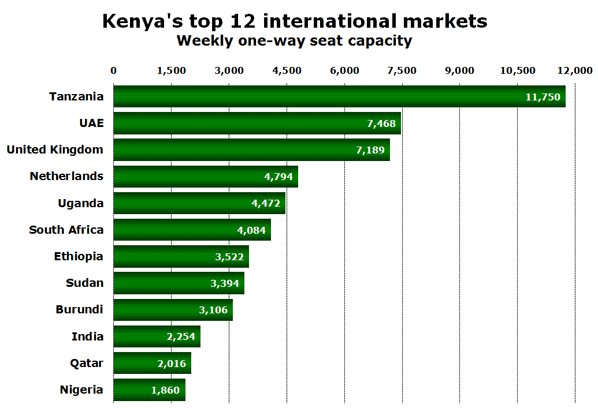
Aviation: Kenya's Top 12 International Markets by Weekly One way seat Capacity


Interesting stats and insight here on Kenyan airlines' Intrernational market. For more information and stats visit OAG Max Online which provides comprehensive schedules database for over 1000 airlines and 3,500 airports.

Anna.aero: Aviation Capacity Study of Kenya

Located on Africa’s east coast, Kenya is roughly the same size as mainland France and has an estimated population of just over 40 million. Famous for its tea, coffee, flowers and athletes, tourism plays a key role in the country’s economy thanks to the many national parks, game reserves and beaches along the Indian Ocean.

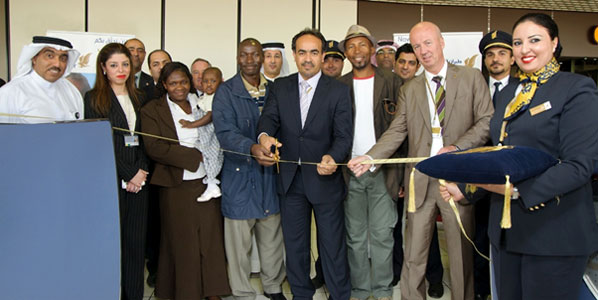
The most recent airline to enter the Kenyan market is Gulf Air, which at the beginning of this month relaunched its route between Bahrain and Nairobi that last was operated in 2002-2003.
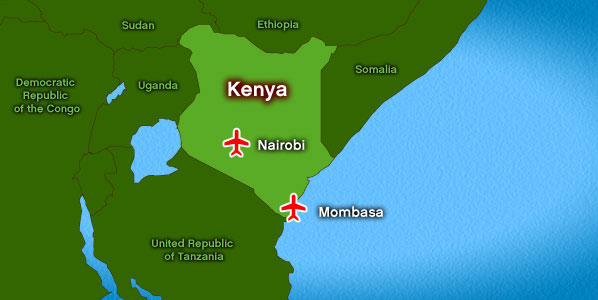
 According to OAG data, Kenya has 19 airports with scheduled flights, although 14 of these only offer domestic destinations. Nairobi’s Jomo Kenyatta International Airport (JKIA) is the dominant airport in the country, accounting for over 70% of all seat capacity. According to data published by the Kenya Airports Authority, the airport handled almost 5.5 million passengers last year, up 8% versus 2009. Over 80% of the airport’s traffic is on international services. The country’s second-busiest airport at Mombasa saw passenger numbers rise by 14% last year to almost 1.3 million. The recent resumption of Gulf Air services from Bahrain means that 38 airlines now serve Kenya’s main airport. Analysis of OAG data for July 2010 and July 2011 shows that seat capacity at JKIA is up 9% this summer, while the number of movements is up 13%.
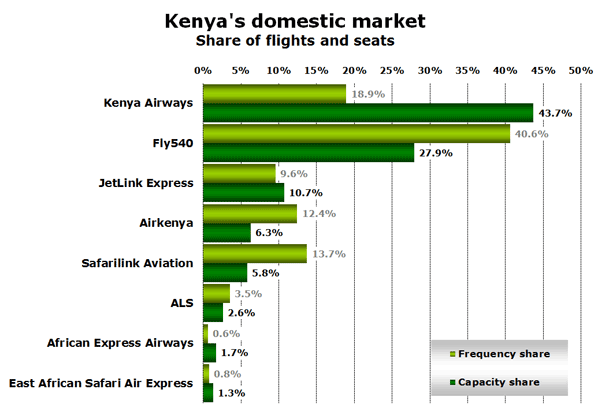
Eight carriers compete in domestic market
Kenya’s domestic air travel market features eight separate airlines offering scheduled services. The biggest in terms of weekly seats is Kenya Airways, which only operates three domestic routes from JKIA, but this includes up to 11 daily flights to Mombasa.

Fly540 offers less seat capacity but operates 20 domestic routes and more than twice as many domestic flights. It offers up to five flights per day between Nairobi and Mombasa. In fact, over 40% of the country’s domestic seat capacity is allocated to this one route between the country’s two most important cities.
Fourth and fifth ranked Airkenya and Safarilink Aviation both operate from Nairobi’s Wilson Airport, which is just five kilometres from the city but has a relatively short runway.

Tanzania, UAE and UK are leading country markets
Kenya’s airports (mostly Nairobi) offer non-stop scheduled flights to 45 countries according to latest OAG data. Leading the way by some distance in terms of weekly seat capacity is neighbouring Tanzania, which generates over 150 weekly departing flights, not just from Nairobi but also Mombasa, Wilson and Kisumu.

Second-ranked UAE is served with just 34 weekly flights, dominated by twice-daily Emirates flights to Dubai, but also daily flights with Air Arabia to Sharjah. The Middle East market is also served by Qatar Airways (double-daily to Doha), Saudi Arabian Airlines, and since the beginning of July, Gulf Air to Bahrain.
Each daily services operated by British Airways, Kenya Airways and Virgin Atlantic to London’s Heathrow Airport help the UK market rank third. Kenya only gained its independence from Great Britain in 1963. Passengers to and from the UK peaked in 2007 at almost 650,000 (Source: UK CAA) before falling dramatically by 23% the following year as a result of the political unrest in Kenya during the first quarter of 2008. For the last two years, the UK market has been relatively stable at around 550,00 annual passengers.SkyTeam member Kenya Airways (slogan ‘The Pride of Africa’) has around 45% of the international market, and is currently flying non-stop to 39 international destinations in 33 countries from Nairobi. Its most recent route launch was last week to Ouagadougou, the capital of Burkina Faso, which it will serve twice weekly (Monday and Friday) via Cotonou (Benin) using a 737-700. The airline has stated that it plans to serve every capital city in Africa by 2013. In June, the carrier took delivery of its second E-190 regional jet, raising its fleet size to 32 (15 737s, six 767s, four 777s, five E-170s and two E-190s).

The next biggest airlines operating international services in Kenya are Ethiopian Airlines and Tanzania’s Precisionair, followed by Emirates.

Brussels Airlines, KLM and Swiss present; but not Air France or Lufthansa
Kenya Airways’ most recent European route was its flights to Rome Fiumicino that launched last December. The airline has around 45% of the international market out of Kenya and ambitious plans to serve every capital city in Africa by 2013.

Launch of the Rome Route by Kenya Airways
Kenya Airways’ most recent European route was its flights to Rome Fiumicino that launched last December. The airline has around 45% of the international market out of Kenya and ambitious plans to serve every capital city in Africa by 2013.

Apart from the UK and Netherlands (Kenya Airways and fellow SkyTeam member KLM both serve Amsterdam daily) there are also daily non-stop European flights to Istanbul with Turkish Airlines, while Swiss offers six weekly flights from Zurich. Kenya Airways operates four weekly flights to Paris CDG and last December began operating three weekly flights to Rome Fiumicino. Brussels Airlines operates three weekly flights from Brussels, while the only German services are provided by Condor from Frankfurt to Mombasa. Lufthansa only operates cargo flights to Kenya.

Air Namibia to be bailed out for the "last time"

The Namibian government has increased the bailout amount for the nation's national carrier Air Namibia with a promise that this will be the last time it will be coming to the aid of the struggling carrier.

The billion-dollar package was worked on a turnaround plan that was approved by the Namibian cabinet. the new business plan, developed by IATA Consulting, will see Air Namibia produce a well develop network that results in a better product attractive to higher yielding customers and to potential airline partners.

New routes yet to be developed, better scheduling and newer aircrafts are expected to boost the productivity of the airline. The plan will see the creation of a hub at Hosea Kutako Airport in Namibia, from where Air Namibia will fly from and to other destinations in the Southern Africa region. 

Zimbawe to build Longest Runway in Africa to woe back airlines

Zimbabwe’s Harare International Airport will have the longest runaway in Africa following a major facelift aimed at luring back major airlines back into the country according to Zimbabwean officials. Zimbabwe's economic freefall that brought the country to its knees also drove airlines away from the country as the route became uneconomical due to a dip in tourist arrivals and trade.

The economy has been rebounding following a power-sharing agreement signed with the opposition and one of the sectors the administration has been keen onrevining is the the critical travel and tourism and industry.

The Civil Aviation Authority of Zimbabwe (CAAZ) will spend US$5 million in the project that will be completed in December this year.

On completion the runway will be five kilometers long with a 30 year lifespan and is designed to accommodate the world’s largest airbus plane. “It will be among the world’s longest runway and the biggest in Africa,” Jerry Ndlovu, the airport director said.

South Africa’s biggest and busiest airport, OR International Airport in Johannesburg has a 4.4 km runway.
A total of 18 international airlines stopped flying into the country after the economic decline set in almost a decade ago. They include Lufthansa, Qantas, Austrian Airlines, Swissair, Air India, Air France and TAP Air Portugal, Egypt Air, Air Mauritius, Linhas Aereas de Mocambique, Air Namibia, Royal Swazi Airlines and Air Seychelles, Air Tanzania, Ghana Airways, Air Uganda and Air Cameroon.

The few airlines that remained faithful in Zimbabwe's hard times were Ethiopian Airlines, South African Airways, Kenya Airways amongst others.
Air France, Austrian Airlines, Egypt Air, Swiss Air, Bulgarian Airlines, Qantas, Emirates, KLM and Lufthansa have indicated that they are now ready to fly back into Zimbabwe.

Selling Air Zimbabwe would be a challenge given its financial state: Minister

Air Zimbabwe is in such shambles and its financial position so hopeless it would be difficult to find takers even if the government decided to offload it, a Zimbabwean cabinet minister has said.

State Enterprises and Parastatals minister Gorden Moyo on Wednesday told the Parliamentary Portfolio Committee on State Enterprises and Parastatal Management that finding an investor to buy the ailing airline was likely to prove a mammoth task.

Moyo was responding to a question by Chiredzi North MP, Ronald Ndava, a member of the Portfolio Committee chaired by Zvishavane-Runde MP, Lawrence Mavima, who had asked him to explain why his ministry was not disposing of loss-making parastatals that were draining the fiscus.

“There are certain entities where we think surely, government should be out of,” Moyo said.

“But it may not be easy to sell Air Zimbabwe right now even if you want to offload it because you may not find a taker because of its state,” he said.

Moyo however said the difficulties facing Air Zimbabwe were not unique to Zimbabwe as a lot other airlines around the globe were performing very poorly. He cited Zambia Airways as an example.

“It is not just Air Zimbabwe which is suffering — very few airlines are doing business and it might be a big problem to sell Air Zimbabwe. A lot of parastatals are faced with huge debts and this on its own makes our parastatals unattractive to suitors. To get investors investing in a shell is not easy because of this debt overhang,” Moyo said. Moyo indicated most of the equipment in the country’s parastatals was dilapidated and archaic. To get investors to inject funds into businesses that were going under was not easy.

“The fiscal space is also too constricted to inject capital or even expertise into these entities especially given the serious human capital flight Zimbabwe has suffered,” he said.

State Enterprises and Parastatal Management deputy minister Walter Chidakwa said the issue of marketability to suitors by ailing parastatals was affected by tariffs.


“The investor looks at prices in Zimbabwe and compares them with those in the world. He looks at whether he will be able to recover his investments and we end up in this dilemma,” said Chidakwa.