Showing posts with label Kenya Airways. Show all posts

Sky Team launches Go Africa Pass

Global airline alliance SkyTeam has launched a new Go Africa Pass, providing cost savings and flexibility on flights operated by Kenya Airways within Africa. Kenya Airways flies to 45 destinations in 36 countries in Africa.

The pass is available to business and leisure travelers flying with any of SkyTeam’s 15 member airlines on an intercontinental round-trip to Africa or a Go Round the World ticket.

SkyTeam Go Africa Pass
 Customers purchasing a Go Africa Pass can opt from a minimum of three to a maximum of 16 flight coupons. Fares are calculated based on the number of miles flown non-stop, offering discounts of up to 75 per cent off standard fares, depending on the itinerary.

Coupons have no minimum stay, open-jaw itineraries are permitted and passengers can stop in each city multiple times. According to the SkyTeam alliance, this gives passengers complete flexibility to plan their trips. The Go Africa Pass is available for sale, for travel starting on or after March 1.

“With continued demand for travel to and within Africa, SkyTeam’s Go Africa Pass complements our already comprehensive network of flights from key global cities to major African destinations,” said Jerome d’Anglejan, SkyTeam’s director of sales. “The Go Africa Pass enables passengers to explore Africa’s full potential by increasing their travel options throughout the continent.”

Kenya Airways operates flights to Nairobi from Hong Kong and Guangzhou in the Greater China Region, as well as from cities in Europe, Asia and the Middle East.

Other SkyTeam airlines with services to Africa include Air France, Alitalia, KLM and Delta Air Lines. Korean Air will start services to Nairobi in June. Future members Saudi Arabian Airlines and MEA also fly to Africa.

SkyTeam’s Go Africa Pass is one of a number of travel passes created by the alliance to offer flexible, economical travel to its global passengers. SkyTeam passes include Go Round the World, Go China, and Go Europe. Customers can contact their local SkyTeam airline, reservation center or travel agent for details and bookings.

The Go Africa Pass, market by Kenya Airways, must be issued in connection with a SkyTeam round trip, open jaw, or round-the-world ticket originating outside Africa with a destination in Africa. These tickets can include frequent-flyer reward tickets.

Reservations for all flights must be completed before departure. Fares per coupon are based on the distance flown. The infant fare is 10 per cent of the regular and for children aged 2 to 11, the child fare is 75 per cent  of the fare.

Travel must be completed within the validity of the intercontinental /round-the-world ticket. There is no limit on stop-overs. All bookings are in economy class.

Rebooking and revalidation is not permitted for the first flight. For subsequent flights, rebooking/ and revalidation is permitted free of charge. There is a no-show charge of US$50. Voluntary re-routing is permitted for a fee of US$50 plus any fare difference and no refund applies.

Other SkyTeam Passes include Go Asia, Go America, Go Europe, Go China, Go Italy, Go Mexico

Details of Sky Team Go Africa Pass

Discover the incredible diversity that Africa has to offer while enjoying complete flexibility in your travels.
Whether for business or pleasure, traveling in Africa will be an unforgettable experience. From spotting the 'Big 5' in the most magnificent wildlife parks, hiking on Mount Kilimanjaro, trying couscous in a Moroccan Kasbah, or enjoying a 'Braai' on a South African beach; the continent is waiting for you to discover its charm.
And one easy, economical ticket can get you there. The Go Africa Pass offers you a choice of 45 destinations throughout Africa, giving you plenty of choice when planning your itinerary.

Travel at Your Own Pace
To be eligible to purchase the SkyTeam Go Africa travel pass, all you need to do is buy an international ticket to Africa on any SkyTeam airline that services the continent. Another starting point can be the Round the World Pass, which you can purchase from any of SkyTeam’s 15 member airlines. Then, simply book your first flight within Africa on Kenya Airways at least 3 days before your international departure. SkyTeam Go Africa allows you to go at your own pace travel whenever you are ready for your next discovery.

Terms and Conditions 

Carrier: Marketed and operated by Kenya Airways.
Eligibility: Must be issued in connection with a SkyTeam round trip/open jaw/round-the-world ticket originating outside Africa with a destination in Africa, including frequent flyer reward tickets.
Number of coupons: min 3, max 16 coupons.
Reservation: Reservations for all flights must be completed before departure.
Ticketing: Ticketing time limit applies.
Fares: Fares per coupon are based on the distance flown.
Infants and children’s fares: Infant 10% of the fare, Child 2-11, 75% of the fare.
Maximum stay: Travel must be completed within the validity of the intercontinental /round-the-world ticket.
Stopovers: No limit. 
Class of service: Economy class.
Changes: 1st flight - Rebooking/revalidation not permitted. Subsequent flights: Rebooking/revalidation permitted free of charge, no show charge of USD50 applies. Voluntary rerouting permitted at USD50 plus any fare difference, no refund applies.
Baggage allowance: Rules of operating carrier apply.
Frequent Flyer: Terms and conditions of respective programs apply.

Email Us at FlightAfricablog@gmail.com

Picture: Kenya Airways Plane in Sky Team Livery!

Isn't it cute? A Kenya Airways B737-700 aircraft will fly the Sky Team colours reflecting the Kenyan carrier's status as the only African representative of the global Airline Alliance.
Kenya Airways aircraft in Sky Team Livery
Bigger image here

Email Us at FlightAfricablog@gmail.com

Kenya Airways to fly a Boeing 737 in Sky Team Colours

Kenya Airways has painted one of its Boeing 737-700 aircraft  in SkyTeam livery  to signify its position as Africa’s representative to the global  airline alliance.

The aircraft will have SkyTeam branding on its tail and fuselage in addition to the Kenya Airways logo thus symbolizing the mutual benefits of the partnership.
The Kenya Airways Sky Team livery
 SkyTeam membership allows Kenya Airways passengers access to over 926 destinations in 173 countries and over 490 lounges globally. Through Kenya Airways, SkyTeam partner airline passengers can access the former’s expansive destination network in Africa.

China Airlines spotting a Sky Team livery
 Kenya Airways Chief Executive, Dr Titus Naikuni, noted that “Our partnership with SkyTeam will enable us to consolidate our presence in the African and global markets in line with our 10-year Growth Plan.”  Dr. Naikuni added that Kenya Airways was a key strategic member in SkyTeam by being Africa’s sole representative with access to 45 destinations in Africa and 11 in the rest of the world.   “SkyTeam is a compelling proposition that enables partner airlines to offer customers additional connections across the globe,” added Dr Naikuni. The SkyTeam livery on the Kenya Airways’ aircraft is also a symbol of the airline’s commitment not only to the alliance but also to delivering high quality service to its customers.

The SkyTeam Livery design was inspired by the alliances logo and features a dark blue SkyTeam logo on the tail fin, the blue SkyTeam ribbon wrapped around the back portion of the white fuselage, the SkyTeam name in large, dark blue letters along the front side of the aircraft fuselage Kenya Airways placed below it.

Email Us at FlightAfricablog@gmail.com

Airline Memorabilia: Kenya Airways, 1999


Kenya Airways was the first African flag carrier to be privatized in 1996. In 1999 the airline was starting an alliance partnership with KLM (which is still today the airline largest private investor) and Kenya Airways flights would connect with the world via the Amsterdam hub.

Around that year KLM was busy trying to build a global airline alliance. Alitalia was also part of the KLM partner airlines, which explains the codeshare flight to Milan.

Kenya Airways Route map taken from the airline's Msafiri Magazine.


Post Courtesy; The Airline Memorabilia blog

Email Us at FlightAfricablog@gmail.com

Kenya Airways Website has a brand new look!

Kenya Airways has redesigned its website giving it a much cleaner and elegant look , with less clutter and links. If you combine the red hot Kenyan colours together with the clean and sleek design, then here we have a world class website. Besides, it's quite fast unlike the South Africa Airways website which caused lots of problems after an overhaul.

The Kenya Airways website reminds me of the KLM website or Emirates website. I would love to know the design company which did this, I have some projects up my sleeve :) What do you think of the new look Kenya Airways website?

Kenya Airways Website Home page

 Kenya Airways Corporate Website


A much cleaner and elegant look


Email Us at FlightAfricablog@gmail.com

Kenya Airways: The Central & West African destinations, mid-2010

Still  series from the TimeTablist continues, this time we travel to Kenya with a routemap showing Kenya Airways Central and West African Destinations:

This detail from the previous post shows Kenya's 13 current and 5 future Central and West African destinations, as of July 2010. All proposed routes: Bangui, Brazzaville, Kisangani, Libreville, and Ndola, have been launched as of the date of this post. The addition of dedicated routes to Brazzaville and Ndola, when nearby Kinshasa and Lubumbashi are already served, added to the addition of such secondary destinations as Bangui and Kisangani, show the thickening of Kenya's coverage and the dominance of the airline across the entire continent. The convergence of the route lines on the right-hand side of this detail indicate the vortex of Jomo Kenyatta International Airport at Nairobi.

Like Delta Air Lines, its Skyteam alliance partner, Kenya Airways has established something of a regional mini-hub at Accra Kotoka, with routes connecting to Abidjan, Freetown and Monrovia-Robertsfield.

The route lines are a bit confusing: Accra-Nairobi flights do not stop in Douala (but the flight to Douala does connect at Bangui), the Abidjan route did not land in Malabo.

Email Us at FlightAfricablog@gmail.com

Kenya Airways Sponsiors Kenyan Sevens Team to the tune of Ksh.290 million

Kenya Airways has signed a huge sponsorship deal worth Ksh.290million($ 3million)for the Kenya Sevens Rugby team. The Kenyan Sevens team has a great international profile and is a regular participant of the Sevens circuit and has given the airline an international profile in terms of branding.


Reports Wolfgang H Thome blog:

18 players and four coaches and staff will under the new and much improved deal get monthly salaries paid, allowing them all to concentrate fully on team affairs and training, besides improved medical coverage and of course the all important tickets to and from major events, where the Kenyans are now a regular side playing in the 8 country / 9 match series. They are again invited to play in Japan, with other matches played in Hong Kong, the United Arab Emirates, South Africa, Australia, New Zealand, the UK and the United States of America.

Brand new kits as well as bonuses for match and series wins too are part of the new deal, which will see Kenya Airways hold all the sponsorship rights for the team, which of course will wear the badge of The Pride of Africa with pride


Email Us at FlightAfricablog@gmail.com

Kenya Airways: The Staggering Cost of Becoming Number 1 in Africa

Carrier Needs over $2 billion to become airline of choice in Africa

Details have emerged about the potential cost of Kenya Airways’ drive to become the number one airline of choice in Africa, connecting the continent’s various destinations via their Nairobi hub.

 Only recently did ‘The Pride of Africa’ sign a record breaking deal of 10 firm orders and 16 options with Brazilian manufacturer Embraer, which, should all options to turn into firm orders as, will double the size of the carrier’s current fleet. Also, when Boeing delivers nine 787 aircraft on firm order, it will allow KQ to add more long haul destinations such as flights to the US, India and the emerging tourism markets in the Far East and the South East.

The cost however is mindboggling with figures ranging from 2+ billion US Dollars upwards, according to sources in Kenya. The forthcoming share rights issue by Kenya Airways is expected to create a core fund to finance this growth, but borrowing and retaining profits at the expense of higher dividends will be other avenue the airline will have to use to be able to pay for the ambitious expansion plans.

At the same time there is intensive lobbying going on to have government boost aviation infrastructure at the country’s main airport in Nairobi, where a second runway is a must to roll out the fleet expansion, while more terminal space and parking spaces for aircraft too are required in order to handle the added passenger and aircraft load. Delays by past KAA management are now coming home to roost as capacity constraints are not only hampering Kenya Airways’ growth plans, but also prevent more airlines from flying to Nairobi or just boosting the number of the existing flights.

 Post courtesy Wolfganghthome blog
Email Us at FlightAfricablog@gmail.com

Kenya Airways to set up a Low Cost Airline, JamboJet

Kenya Airways is set to form a low-cost subsidiary to handle its regional operations, opening a new battlefront with budget operators such as Jet Link, Fly540 and Air Kenya for control of the Eastern Africa routes.
The launch of the KQ’s budget line — Jambo Jet — marks a u-turn after the airline absorbed its then low-priced unit known as Flamingo Airlines to its group operations in 2004.
The rise in passenger numbers within eastern Africa, including Uganda and South Sudan, coupled with the rising competition for control of this market seem to inform the national carrier’s decision to establish a subsidiary for local and regional flights.
The airline’s CEO Titus Naikuni said on Monday that the regional unit will have a leaner costs structure compared to those of international airlines—signalling a cost-saving plan that will strengthen its hand in the ongoing price war.
“Jambo Jet is being formed and we are still in the early stages of it,” said Mr Naikuni without giving details.
This is the latest signal from KQ of its intention to wrest regional routes from rivals Jet Link, Fly540 and Air Kenya that have in recent years been aggressive in pursuit of the ever growing passenger base. It also part of the global trend where international carriers are forming subsidiaries to handle local routes and free executives to handle the more complicated international travel besides enjoying costs savings from leaner operations.
South African Airlines runs the local Mango Airline while British Airways has a majority stake in Comair—which serves southern African nations including Lesotho, Namibia and Botswana.
Kenya Airways generates about five per cent of its sales from its Kenyan routes and is keen to grow this share to double digits as the rising middle class opts for air travel over road transport.
The formation of the East Africa Common market coupled with the split of Sudan, which has created Africa’s newest state South Sudan, has also created increased air travel in the region.
Other regional operators reckon that the KQ budget subsidiary will renew to renew the ongoing battle for control of the domestic and regional markets with pricing set to emerge as key market share driver.

The national carrier has been cutting fares on its domestic routes.
“When an Airline like Kenya airways enters the business you are in, you must be prepared or risk being pushed out of business,” said Nixon Ooko, the operations director at Fly540.

Post Credit. Business Daily
Email Us at FlightAfricablog@gmail.com

Kenya Airports Authority Lying to the Public over Vandalism Claims

The Kenya Airport Authority only managed to pour more fuel into the fire of discontent over their dismal performance of late, when their Managing Director yesterday blamed vandals for the power outages.


Incompetent? Eng. Stephen Gichuki, Kenya Airports Authority Managing Director
‘The man is not only incompetent, and his staff responsible are incompetent too, now they are also lying to us. How can they blame vandalism of cables in a secured area. Has anyone heard of intrusion into the airport perimeter, cutting of fences or climbing them? Had police got any evidence that there was in fact vandalism or that the power substation was broken into? Has KAA filed a case with police? That cable is underground so who can access it from above? And if anyone intruded into the secure area, what does that mean for KAA’s security measures in place? This is pure hogwash and they know it. They are trying to absolve themselves from blame and by lying make it worse. They must resign or be fired for negligence and incompetence. And no, you cannot use my name because these people are very vindictive and can cause our airline a lot of problems’ said a regular source to this correspondent yesterday evening when discussing KAA’s latest attempt to shift blame from themselves to ‘others’ who remain unnamed.

Airlines are demanding huge compensation from KAA for flight diversions and the resulting costs of passengers missing flights and having to be accommodated, the extra fuel to reach diversion airports and related cost caused by a string of recent power outages at East Africa’s most important international aviation gateway. Meanwhile is a crippling electricity deficit of up to 200 MW causing power rationing across Kenya, following suit to Tanzania’s perennial power shortages and of late similar problems in Uganda, leaving businesses, in particular the hotel industry and manufacturing reeling from the added cost of doing business by using in house generators which at present prices of diesel and petrol are eating deep into their bottom line.

Anna.aero: Aviation Capacity Study of Kenya

Located on Africa’s east coast, Kenya is roughly the same size as mainland France and has an estimated population of just over 40 million. Famous for its tea, coffee, flowers and athletes, tourism plays a key role in the country’s economy thanks to the many national parks, game reserves and beaches along the Indian Ocean.

The most recent airline to enter the Kenyan market is Gulf Air, which at the beginning of this month relaunched its route between Bahrain and Nairobi that last was operated in 2002-2003.
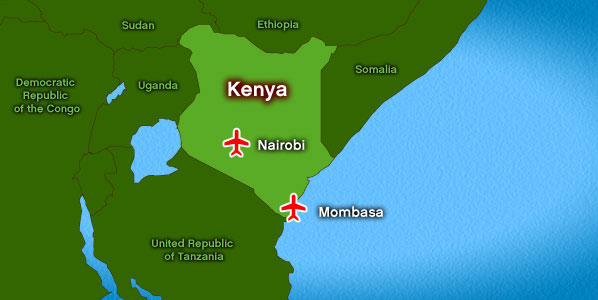
 According to OAG data, Kenya has 19 airports with scheduled flights, although 14 of these only offer domestic destinations. Nairobi’s Jomo Kenyatta International Airport (JKIA) is the dominant airport in the country, accounting for over 70% of all seat capacity. According to data published by the Kenya Airports Authority, the airport handled almost 5.5 million passengers last year, up 8% versus 2009. Over 80% of the airport’s traffic is on international services. The country’s second-busiest airport at Mombasa saw passenger numbers rise by 14% last year to almost 1.3 million. The recent resumption of Gulf Air services from Bahrain means that 38 airlines now serve Kenya’s main airport. Analysis of OAG data for July 2010 and July 2011 shows that seat capacity at JKIA is up 9% this summer, while the number of movements is up 13%.
Eight carriers compete in domestic market
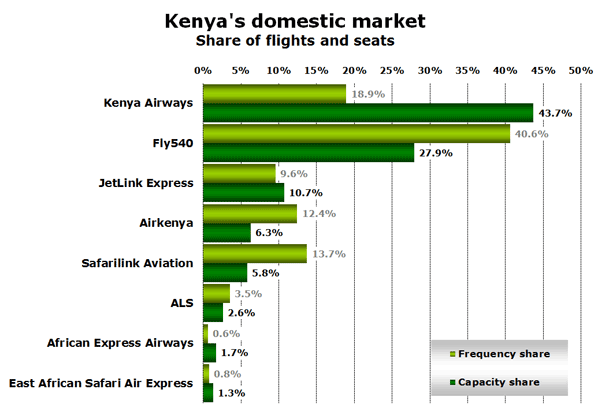
Kenya’s domestic air travel market features eight separate airlines offering scheduled services. The biggest in terms of weekly seats is Kenya Airways, which only operates three domestic routes from JKIA, but this includes up to 11 daily flights to Mombasa.

Fly540 offers less seat capacity but operates 20 domestic routes and more than twice as many domestic flights. It offers up to five flights per day between Nairobi and Mombasa. In fact, over 40% of the country’s domestic seat capacity is allocated to this one route between the country’s two most important cities.
Fourth and fifth ranked Airkenya and Safarilink Aviation both operate from Nairobi’s Wilson Airport, which is just five kilometres from the city but has a relatively short runway.

Tanzania, UAE and UK are leading country markets
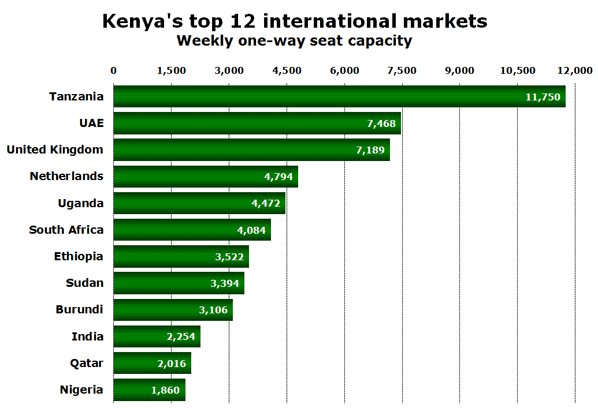
Kenya’s airports (mostly Nairobi) offer non-stop scheduled flights to 45 countries according to latest OAG data. Leading the way by some distance in terms of weekly seat capacity is neighbouring Tanzania, which generates over 150 weekly departing flights, not just from Nairobi but also Mombasa, Wilson and Kisumu.

Second-ranked UAE is served with just 34 weekly flights, dominated by twice-daily Emirates flights to Dubai, but also daily flights with Air Arabia to Sharjah. The Middle East market is also served by Qatar Airways (double-daily to Doha), Saudi Arabian Airlines, and since the beginning of July, Gulf Air to Bahrain.
Each daily services operated by British Airways, Kenya Airways and Virgin Atlantic to London’s Heathrow Airport help the UK market rank third. Kenya only gained its independence from Great Britain in 1963. Passengers to and from the UK peaked in 2007 at almost 650,000 (Source: UK CAA) before falling dramatically by 23% the following year as a result of the political unrest in Kenya during the first quarter of 2008. For the last two years, the UK market has been relatively stable at around 550,00 annual passengers.SkyTeam member Kenya Airways (slogan ‘The Pride of Africa’) has around 45% of the international market, and is currently flying non-stop to 39 international destinations in 33 countries from Nairobi. Its most recent route launch was last week to Ouagadougou, the capital of Burkina Faso, which it will serve twice weekly (Monday and Friday) via Cotonou (Benin) using a 737-700. The airline has stated that it plans to serve every capital city in Africa by 2013. In June, the carrier took delivery of its second E-190 regional jet, raising its fleet size to 32 (15 737s, six 767s, four 777s, five E-170s and two E-190s).

The next biggest airlines operating international services in Kenya are Ethiopian Airlines and Tanzania’s Precisionair, followed by Emirates.

Brussels Airlines, KLM and Swiss present; but not Air France or Lufthansa
Kenya Airways’ most recent European route was its flights to Rome Fiumicino that launched last December. The airline has around 45% of the international market out of Kenya and ambitious plans to serve every capital city in Africa by 2013.

Launch of the Rome Route by Kenya Airways
Kenya Airways’ most recent European route was its flights to Rome Fiumicino that launched last December. The airline has around 45% of the international market out of Kenya and ambitious plans to serve every capital city in Africa by 2013.

Apart from the UK and Netherlands (Kenya Airways and fellow SkyTeam member KLM both serve Amsterdam daily) there are also daily non-stop European flights to Istanbul with Turkish Airlines, while Swiss offers six weekly flights from Zurich. Kenya Airways operates four weekly flights to Paris CDG and last December began operating three weekly flights to Rome Fiumicino. Brussels Airlines operates three weekly flights from Brussels, while the only German services are provided by Condor from Frankfurt to Mombasa. Lufthansa only operates cargo flights to Kenya.

Change Makes Change: Kenya Airways Launches Onboard Donation Platform

Kenya Airways, the Pride of Africa, recently launched an online donation platform, Change Makes Change, to help fund its Corporate Social Responsibiluty programs. The airline's CSR programs have in the past involved refurbishing schools, planting seedlings and various other social programs in the countries it operates in.


Should passengers be paying for an airlines' CSR programs? That's question for another day. According to the airline's CEO, Dr Titus Naikuni, the program has factored in customers wish on where those donations should be channeled to.

But many Kenyans have a pretty good idea where those donations should be channelled-to the North of the country where chilling images of starvation have been emerging in the last week. But which airline would 'traumatize' its passengers with images of starvation? That's why Kenya Airways CSR is targetted towards social programs like greening the planet and so forth. Many airlines, including KQ, will portray a glamorous picture of their home countries; so for most Kenya Airways passengers the image of Kenya that will be printed in their minds, atv least onboard, is that of an enchanted land of safari, adventure, a cool and emerging high tech city, the nightlife and many blissful things in life. For now, the images of starvation will be sweeped under the frilly doilies.

Kenya's aviation sector: Who next to fall to hard times?

Aviation in Kenya is generally a thriving industry with the number of aircraft registered and the daily flights recorded at the main airports, at Wilson, and across the entire country’s airfields and airstrips dwarfing the entire rest of the East African Community. No cause for concern then one might think. Think again.


Jet aviation, connecting Nairobi with Malindi, Mombasa, Kisumu and Eldoret, has seen a mighty change take place when Kenya Airways (KQ) decided to return to the domestic aviation market per force, re-constituting the shuttle to and from Mombasa and returning to both Malindi and Kisumu after runway expansions and repairs had permitted "The Pride of Africa" to do so.

The introduction of new aircraft to the KQ fleet, namely the Embraers 170 and 190 models, has allowed them to fly as many as 10 times between Nairobi and Mombasa a day, and while flights to Malindi are only daily at present, more can be added should demand so require, as was the case with Kisumu.

While Kenya Airways was absent from the Kisumu and Malindi routes and had shown for some time less inclination to claw back market share on the Mombasa route, this changed with the arrival of the Embraers, and it also changed the entire market equation for the privately-owned airlines, which had taken advantage of KQ’s "slumber." Jetlink and Fly 540 – the latter has already taken over East African Safari Air Express – found themselves in a sudden fight to the death over passengers and had to reduce fares while still maintaining the same number of flights in spite of lower occupancies.

With fuel prices escalating at the same time, margins started to shrink and aviation observers now think that with KQ’s unrelenting presence and pressure on the domestic market, with new aircraft, inventive marketing, and a superb frequent flyer loyalty program, it will only be a matter of time before something, or someone, finally gives.

Several reasons can be cited for this development in Kenya’s mainstream aviation.

First, there is the need to bring modern aircraft to the fleets, causing aged DC 9s and F28s to be phased out, as this is a demand in the market place. These ageing aircraft were cheap to procure though expensive to operate, considering their fuel consumption, an acute issue when the cost of aviation fuel JetA1 soars. Kenya Airways bringing new aircraft on stream almost inevitably compels competitors to do the same, and though the present CRJs flown by Jetlink and Fly540 are not brand new, they do constitute the newer aircraft the market was looking for. That, however, required often syndicated funding, and with interest rates again on the rise, the payments for these newer aircraft are becoming a challenge for such comparably small privately-owned airlines.

Secondly, in particular, pilots are becoming a real issue for smaller airlines as they are just as much in demand by the national airlines – where they have "real" career prospects of eventually migrating to wide-bodied planes and to fly further abroad. However, aggressive recruitment by, in particular, airlines from the Middle East, where a severe pilot shortage is said to be looming, considering the ongoing expansion of their main players like Emirates, Etihad, Qatar, Oman, Air Arabia, and Fly Dubai, also plays a major role for qualified pilots in Eastern Africa, and it is little surprise that those remaining at home have flexed their muscles and successfully re-negotiated their terms and conditions to a point of near financial pain for the smaller airlines and also for Kenya Airways, which only recently had so sign a new deal with their pilots and KALPA. This has eaten deeper into the narrower margins of smaller airlines, making it more difficult to make financial ends meet.

Thirdly, the return of KQ in numbers to the Mombasa route and to Malindi and Kisumu has eaten into the client base of smaller jet airlines, and the at times extraordinary special offers to fly with "big brother" Kenya Airways has eroded occupancies of those private airlines, which can only make ends meet with regular high occupancies on one side and efforts to keep their fares up – both elements in this equation, however, no longer hold, as pressure on fares has been intense while occupancies have actually reduced, in particular, during the long and hard low season between after Easter until the end of June.

All of this is taking its toll and the report today from Kenya that one of these private airlines is being taken to court by another demanding protection from asset shifts and cash transfers, which would potentially make it impossible to receive a settlement, should the original suit over some US$900,000 in dispute be decided in their favor, only is the tip of the iceberg it was learned.

"Times are tough right now, tourism is just entering its mid season, inflation is running high, and the shilling is low, which makes procurement of spares and external services like insurance or maintenance a lot more expensive in shilling terms. So business and leisure travel is not as heavy as we would like, and the elections next year are not helping us either. It is a difficult period for private airlines now.

"Kenya Airways now even flies twice a day to Juba, where a year ago they did not fly at all. This left the route to us and another Kenyan airline, and now there we also have to share the cake like for Mombasa and Kisumu. Our financial resources are more limited, our cash flow is more limited [than] that of KQ, and who knows, maybe in a few weeks or months another private airline is going to fold over financial issues," said one regular source from Nairobi, sounding not exactly convincing though and certainly not as cheerful as usual when passing information, as always under the cover of strict anonymity, to this correspondent.

For now it remains to be seen where the present situation is taking the aviation industry in Kenya, and while the safari airlines report booming business, in particular on their services to and from the Masai Mara where the great migration is presently underway, others are not so lucky.

Source eturbo-news

Kenya Airways CEO Rejects AFRAA worries over Gulf Carriers, Adds More Middle East Routes

Kenya Airways chief, Titus Nalkuni, has rejected claims by AFRAA that Gulf airlines pose a threat to African aviation growth by poaching staff.

“We have lost just three or four staff to a Gulf airline and two of those came back,” Nalkuni said at the Embraer organised Connectivity in Africa conference in Nairobi this morning.

Kenya Airways Chief Dr Titus Naikuni
“In fact we have so many unemployed highly educated people here, they would be doing us a favour. Take them,” Nalkuni said.

Nalkuni said the East African airline had extensive plans for growth over the next ten years and has just agreed deals for two new B777-300ER aircraft from Boeing and leased a B747 freighter and two B737 freighters to give the growing cargo business a boost when they join the fleet in October.

The B777s will be delivered in 2013 and will be utilised on routes to the Indian subcontinent.
Kenya Airways is to begin flights to Beirut and Jeddah later in the year.

“We are still working on the Jeddah details,” Nalkuni said, “ There is a problem with slots at the moment. The times that we are being offered don’t fit in with our schedule.”

Investment in the infrastructure at Nairobi’s Jomo Kenyatta international airport and the roads around it has given a boost to the Kenyan economy and to the national airline.

“We have a shortage of pilots,” Nalkuni said, “We have introduced new training schemes to encourage and support Kenyan nationals, but we will also be hiring foreign captains, particularly for our Boeing 737 fleet.
“And our conditions are better than the Middle East,” he laughed.

Kenya Airways CEO Titus Naikuni Interview with CNN

CNN's David McKenzie sat down with Kenya Airways CEO Dr. Titus Naikuni to discuss the recent growth of the African airline industry.

CNN: Kenya Airways is expanding rapidly in Africa. Why is Africa such a good market for you?
Titus Naikuni: I don't think we're expanding rapidly -- if you ask me, I would have wanted to expand three times what we are doing right now.
But we've got limitations in terms of getting the right pilots, in terms of getting traffic rights -- because it's a political business where you don't just wake up one morning and decide to fly into a particular destination.
Africa is important to us and dear to us because it's a growing market. It's still, to me, unserviced. If you look at West Africa, it's not fully serviced. If you look at some pockets in Central Africa, it's not serviced.
And even when it's serviced, I don't think we are providing the best service because we're going to only one frequency in between some destinations. We still have restrictions, in the sense that you can't move from one city to another and pick up passengers.

CNN: So if you fly from Nairobi to Lagos, you can't pop over to Abuja, pick up people and come back to Nairobi. Why is that?
TN: It's just the political nature of the business, protectionism. People are protecting their own skies. In some countries, it is possible. You are able to negotiate. It's called freedom rights.

CNN: You would think these countries, which effectively, most of them don't have a viable national carrier, would want a service for their customers.
TN: Yeah, I mean, that's common sense, but common sense is not always common. In some countries there is that realization. In other countries, it's not there.
We're Kenyan by name, but if you look below the name Kenya, you see the pride of Africa ... and so yeah, we're a de facto national carrier for some of the countries.

CNN: Who is your ideal customer in Africa? What sort of person?
TN: We have a real mix here, because you have the traders ... you have the (new) investors ... say from India. Then you have the traditional investors who've been in Africa for long, from Europe ... and then you have the tourists, depending on which country you're looking at.

CNN: Some of the regions you're going to aren't necessarily the most stable places. Does that worry you from a business perspective to take this leap and say, 'I'm going to be flying to Abidjan on a weekly basis' and then have those hits to the business?
TN: We have a very huge security system where ... we do an assessment of every country before we decide that we're going to fly into it. In fact, like Abidjan... we had our own person on the ground who was advising not to do it and we stopped.

CNN: What are some of the big challenges of flying into new routes, even like Juba in Southern Sudan? What keeps you up at night?
TN: The challenges are -- first of all, the experience of the staff that are there, because some of these countries don't have the right personnel. You're looking at air traffic controllers, you're looking at ground facilities and so forth, but we do carry out audits before we go in there.
So really, the thing that makes me awake at night is whether some of the navigation aids are working or not in some of the airports.

CNN: What is the advantage from a business perspective, of getting into these places first, as a major carrier -- given the fact that you've got South African Airways and Ethiopian Airways, the other two big players in the African market?
TN: I think the advantage you have over the others if you get in first is that you start getting customers early enough and you make sure that you implant yourself in the minds of the people.
I don't ignore the fact that the two carriers mentioned are major competitors and we compete and sometimes cooperate in some situations.

You can watch the full video of interview on CNN, it seems CNN does not allow embedding of their videos. They want to run some 10 second ads on them.

Kenya Airways goes Double daily to Juba Now

Effective immediately, more likely to have kept the competition in the dark until it actually happened, has Kenya Airways, the Pride of Africa, introduced twice daily departures between Nairobi and the soon to be capital of the new independent Republic of South Sudan.

In time for the Independence Day celebrations on the 09th of July will KQ now add a departure at 07.45 hrs in the morning, timely for all network connections arriving from the wider East African region, while keeping the mid day departure.

Until the 06th September there will be no second flight on Tuesdays at which time the frequency will truly be double daily.

Competitors were taken reportedly unaware of this ‘coup’ by Kenya Airways, and by using their latest Embraer 170 and 190 aircraft, depending on passenger loads, travelers will enjoy a state of the art modern jet aircraft with full inflight service and the usual two cabin lay out offering business and economy class.

Happy Landings!
Email Us at FlightAfricablog@gmail.com

Source:Wolfganghthome's Blog

Kenya Airways Opens New Lounge at JKIA

The Pride of Africa has just announced the opening of a brand new lounge for SkyTeam Platinum and
Gold Card Holders, offering their own and partner airlines’ valued frequent fliers the best available lounge standards found anywhere at the Jomo Kenyatta International Airport.

The new facility, able to accommodate up to 90 passengers in transit or awaiting their departure flights, will be able to enjoy hot showers, novel for JKIA, but also other amenities like super fast wireless internet access, hot meals, snacks and drinks besides superior range of reading materials and access to leading news and business channels on DSTV.

The new lounge is now available to entitled passengers besides the ‘regular’ Simba Lounge for business class passengers which offers in particular passengers on regional and continental services an oasis of tranquility in the otherwise hustle and bustle of East Africa’s busiest airport. Said Kenya Airways’ CEO Dr. TitusNaikuni during the opening function: ‘The opening of this new and outstanding facility continues to set us apart from other continental airlines and continues to entrench our position as an international airline. It also elevates the profile of our hub, the JKIA, in line with our new SkyTeam status’.

Article courtesy Wolfganghthome's Blog

Addis Ababa, Nairobi, Best Locations For Airline Hubs In Africa

Addis Ababa in Ethiopia and Nairobi, Kenya are the best locations for the the creation of airline hubs in Africa, the Malaysia-Africa Business Forum recently revealed in a study.

Ethiopia's Precise Consult International PLC managing partner Henok Assefa said this was because the best connections to African destinations were actually provided by Kenya Airways and Ethiopian Airlines.

He pointed out that Ethopian Airlines, an over-a-billion dollar company, right now flew to about 60 countries, which included more than two dozen flights weekly to India and China.

"The airlines industry is growing very fast in Africa even when the global aviation industry is falling apart. All African airlines, the one that are run well, happen to earn profits.

"We need more help and I know for sure, AirAsia, or any airline in Malaysia, would like to make a connection," Assefa said in response to a proposal by former prime minister Tun Dr Mahathir Mohamad that African countries should come together to set up airline hubs to derive more benefits and increase inter-connectivity.

Dr Mahathir has suggested that low-cost airlines such as AirAsia seriously consider flying to Africa to facilitate travel and increase trade and investment linkages.

Currently, Johannesburg in South Africa is the known hub for Africa.

Source: Ethiopian Investor