Showing posts with label Ethiopian Airlines. Show all posts

Ethiopian Airlines to use the Dreamliner in the Johannesburg Route

Ethiopian Airlines will deploy the B787 Dreamliner on the Johannesburg Route from June this year according to the Global Distribution System(GDS) timetable for the airline.

Reports Airline Route

ET’s Boeing 787 seats 270, including 24 Cloud 9 Business Class and 246 Economy Class.
Planned Boeing 787 operation as follows. Although routes mentioned below are now opened for reservation, there is a chance for 787 inaugural date to be altered pending on delivery time frame.

 Routes to be serviced by the Dreamliner will include Addis-Dubai, Addis-Johannesburg, Addis-Guangzhou, Addis-Harare and Addis-Lusaka.


Addis Ababa – Dubai eff 15JUN12 ET600/601 operates with 787, replaces 767/77L (EXCEPT 16AUG12 – 15SEP12)
ET600 ADD2215 – 0300+1DXB 787 D
ET601 DXB0435 – 0740ADD 787 D eff 16JUN12
Addis Ababa – Johannesburg eff 15JUN12 Daily 787 service replaces Boeing 767
ET809 ADD0850 – 1330JNB 787 D
ET808 JNB1420 – 2050ADD 787 D
Addis Ababa – Guangzhou eff 15AUG12 Daily nonstop flight replacing Boeing 767 via Bangkok
ET606 ADD0030 – 1515CAN 787 D
ET607 CAN2300 – 0600+1ADD 787 D
Addis Ababa – Harare eff 18SEP12 Service operates Day x246, replacing 767-300 (Day 246 with 737-800; this route from 16SEP12 operates nonstop in both direction)
ET873 ADD0920 – 1245HRE 787 x246
ET872 HRE1440 – 1955ADD 787 x246
Addis Ababa – Lusaka eff 18SEP12 Service operates on Day 246, replacing 767 (this route from 16SEP12 to operate nonstop in both direction)
ET883 ADD0910 – 1215LUN 787 246
ET882 LUN1500 – 2005ADD 787 246


Email Us at FlightAfricablog@gmail.com

Airline Memorabilia: Ethiopian Airlines 1989/1990

Ethiopian has always been one of the main, biggest players in the African market. It is, and always has been, a very well-run airline as well.

Ethiopia was a People's republic at the time, and as such Ethiopian flew to places such as Moscow or Berlin in the GDR (using a 727 and flying via Cairo). Futher political changes since then: Eritrea was still part of  Ethiopia and Yemen was split up in two countries...

Note the airline slogan at the time: Bringing Africa Together


Post Courtesy: Airline Memorabilia

Email Us at FlightAfricablog@gmail.com

Ethiopian Airlines Studying More Routes in Far East Asia

 Ethiopian Airlines is planning to strengthen its Asian route network in the near future and is currently studying possible future destinations in the Far East such as South Korea, Malaysia and Singapore and further destinations in China according to the airline's CEO Tewolde Gebremariam. Ethiopian has been lying to China for the last 30 years and was the first foreign airline to service the Chinese market.

Currently, Ethiopian Airlines flies to seven destination in Asia including Bangkok, Delhi, Hong Kong Mumbai and three Chinese cities; Beijing, Hangzhou and Guangzhou. South African Airways is expected to launch its first flights to Beijing mid this month.

Ethiopian Airlines is also considering developing new routes in Morocco, Tunisia, Libya and Algeria. Currently, Ethiopian Airlines flies only to Cairo in Egypt. Kenya Airways is also expected to launch lights to Tripoli and Tunis soon.

Email Us at FlightAfricablog@gmail.com

Ethiopian Airlines: The Eastern and Southern African Routes 2011

Ethiopian Airlines

Ethiopian Airlines has long been the premier carrier of the African continent. Prior to the establishment of many state carriers (or even the independence of some African nations), the wings of the Lion of Judah was lauded for its technical proficiency and service.

The airline has not let time, and the development of other formidable African airlines (especially neighboring Kenya Airways), diminish its presence of the continent or its standing as a global carrier. Many African countries lack a home airline or flag carrier, and in the rapid consolidation of airlines around global alliances, it is the largest operations that seem destined to retain their identities. Ethiopian is unquestionably well-positioned as a regional, continental, and global airline.


Over the next four posts, Timetablist will detail Ethiopian Airlines current planet-wide network, which reaches four continents, including an impressive presence in Europe and growing service to China.

In this first post, the headquarters hub at Addis Ababa's Bole Airport pulls in passengers from across Central, Eastern, and Southern Africa.


Post Courtesy: The Timetablist
Email Us at FlightAfricablog@gmail.com

Ethiopian Airlines International Route Map 2011

Ethiopian continues to have more comprehensive services across Asia than its regional rival, Kenya Airways. Riyadh, Kuwait, Jeddah, Abu Dhabi, Bahrain, Tel Aviv and Beirut are all exclusive to Ethiopian and reflect the country's links with the entire Gulf region, including Israel. 

Likewise, whereas Kenya Airways serves only Mumbai, Ethiopian serves Delhi (curiously, here marked "New Delhi") and from there on to Beijing, which is one of four cities in East Asia. Remarkably, it was recently announced that Ethiopian will add a fourth Chinese city, Hangzhou, to its route map in 2011.


Post courtesy: The Timetablist
Email Us at FlightAfricablog@gmail.com

Ethiopian Airlines to become the largest Airline in Africa by 2025

Ethiopian Airlines is one of the largest and most profitable carriers in Africa. It has 34 aircraft on order, including 10 B787-8s with a network of 56 international destinations and 17 codeshare partners.

It's a Star Alliance member and in 2010 had an operating profit of ETB1.6 billion (USD92 million). Ethiopian has forged a successful path for its expansion plans and has come a long way since its beginnings as a joint venture between the Ethiopian Government and Trans World Airlines.

The carrier has set an ambitious, but realistic, 15-year strategic plan that includes becoming the single largest airline in Africa. It intends to generate revenues of ETB171 billion (USD10 billion) per year, acquire a fleet of 70 aircraft and improve its Skytrax customer service ranking from three to four stars.

If successful, the plan would make Ethiopian Airlines the largest and most profitable carrier in Africa.
Ethiopian Airlines’ 15-year strategic plan

Measure Current Goal
Revenue USD1.6 billion p/a USD10 billion p/a
In service fleet 47 70 “modern” aircraft
SkyTrax Customer service rating 3 4

The largest on-order fleet in Africa, both passenger and freighter

The African launch customer for the B787-8 made its order in 2006 and originally planned to have the aircraft in service by Jun-2010 on the Guangzhou route. However, like many of Boeing’s B787 customers, the Dreamliner delays have left Ethiopian behind on expansion plans. The carrier currently has 36 aircraft on order, the most of any African carrier.

In 2010, Ethiopian placed its largest order to date – 12 A350-900s, due for delivery between 2016 and 2019. The order was designed to give Boeing a wake-up call – implying that its long-time African operator was unhappy with the delays, and that it was prepared to look elsewhere for new aircraft. Despite the apparent threat, Ethiopian Airlines reaffirmed its Boeing order and is expecting its first B787-8 between 12-Mar-2012 and 15-Jun-2014, not Jan-2012 as originally thought. Ethiopian stated the new aircraft, both the B787-8s and the A350-900s, would be used to complement and replace its existing fleet, with the A350s to be deployed on services to the Far East and the Americas, and the B787-8s likely to replace B767s and B757s.

Ethiopian’s freight network supports the country’s trade relations

A strong point in Ethiopian Airlines’ portfolio is its substantial freight operation, with a dedicated cargo fleet of five aircraft and four B777-200LRFs on order. Cargo and freight services accounted for 17% of its total 2010 revenue. The carrier serves more than 40 destinations in its freight network through dedicated freighters and belly space on passenger aircraft.

Ethiopian Airlines’ dedicated freight network
Ethiopia’s largest trade partners are the European Union, China, the US, Saudi Arabia and India. Ethiopian Airlines operates a dedicated cargo network to all those countries bar China and the US, although belly capacity, codeshare partners and sea links enable trade to these countries to remain strong. Ethiopia’s trade with other African countries is relatively weak, with Sudan, Tunisia and South Africa the only countries being a top 20 trading partner.

Ethiopia’s major trade partners: 2010

Ethiopian will give Star Alliance three main bases in Africa

Ethiopian recently joined the Star Alliance, an event that coincided with the B787 Dream Tour of Ethiopia. Ethiopian, mentored by Lufthansa, joined fellow African Star Alliance members South African Airways and EgyptAir, as the alliance extends its coverage to all but the west and centre of the continent. In the lead-up to the approval, Ethiopian Airlines established codeshare agreements with several key Star Alliance members, the latest being Singapore Airlines, and the most important being founding members SAS and Lufthansa.

Ethiopian Airlines’ codeshare partners: 2011
Airline
Since
Region
Dec-2007
Asia Pacific
n/a
Asia Pacific
n/a
West Africa
Mar-2003
Asia Pacific
Jul-2000
Europe
Dec-2009
Europe
Jul-2008
North Africa
n/a
Middle East
n/a
Middle East
n/a
East Africa
Lufthansa
May-1997 F
Europe
n/a
Central Africa
SAS
May-1997 F
Europe
n/a
Middle East
Singapore Airlines
01-Apr-2000
Asia Pacific
South African Airways
Apr-2006
Southern Africa
Apr-2008
Europe
Ethiopian’s entry into Star Alliance means the global airline group will have three main bases in Africa – Addis Ababa, Johannesburg and Cairo. Ethiopian hopes Star Alliance membership will significantly boost Addis Ababa International Airport’s role as a prominent African gateway, boosting revenues, reputation and presence.

Most seats in Africa are unaligned, Star next best

SkyTeam occupies a relatively strong presence in Africa through Air France-KLM and Kenya Airways. Air France and KLM have each built networks on the continent based around their longstanding colonial linkages. While leading Star member Lufthansa does not have the same historical ties as Air France and KLM, it does have fellow alliance members in the north, south and now the east of the country. Star made a point of recruiting strategic partners that spread across the continent, to complement the more than 50% of Star members that operate to Africa.

Africa seats capacity by alliance (before Ethiopian Airlines’ official joining of Star Alliance): 31-Oct-2011 to 06-Nov-2011
Within Star, EgyptAir provides a most challenging partner for Ethiopian Airlines. Both EgyptAir and Ethiopian serve a handful of destinations in the Asia Pacific including Beijing, Guangzhou, Bangkok and Mumbai, aiming to feed in traffic from the African continent. Star will benefit from Ethiopian’s African network as it is more established than the Egyptian flag carrier, particularly in West Africa, while EgyptAir is much stronger in North Africa. Each carrier serves points in the Middle East – Kuwait, Bahrain, Riyadh, Beirut, Tel Aviv, Jeddah, Sana’a and Muscat – creating considerable overlap in Star’s Middle Eastern network and, again, in their respective goals for feeding beyond traffic from Africa.

Limitations and benefits in Ethiopian’s network

Ethiopian serves many of the mineral-rich African countries, offering valuable additions to Star’s network. These include the Democratic Republic of the Congo (gold and diamonds), Namibia (via codeshare – lead, zinc, diamonds), Botswana (diamonds) and South Africa (iron, oil). Ethiopian also serves fast growing African economies, such as Rwanda, Ghana, Angola, Kenya and Nigeria.

A sub-region missing from Ethiopian’s network is northern Africa, where it offers service only to Cairo – already well covered by EgyptAir. Important gaps in its network include the oil- and iron-rich countries of Libya and Morocco in North Africa, each better covered by EgyptAir – which serves one destination each in Morocco, Tunisia, Algeria and two in Libya – with the natural advantage of serving multiple destinations within Egypt. But together Ethiopian and EgyptAir have Africa covered for Star.

Ethiopian competes with Middle Eastern carriers on air link to China

Ethiopian was the first foreign airline to operate into China more than 30 years ago. At that time a political link, it has proven a valuable and longstanding connection into the Asian powerhouse. Times have changed however; though Ethiopian may have been safe from competition 30 years ago, this is no longer the case and Middle Eastern carriers are rapidly expanding alternative links between the region’s oil- and mineral-rich countries and China. Eight Middle Eastern carriers now operate between China and the Middle East including Emirates, Qatar Airways, Etihad, El Al, Mahan Airlines, Saudi Arabian Airlines, Yemen Airways and Iran Air.
Top 12 carriers operating between the Middle East and China
by seats per week: 31-Oct-2011 to 06-Nov-2011
Only two airlines operate third and fourth freedom services between Eastern Africa and China – Ethiopian Airlines and Air Mauritius – offering approximately 9500 seats per week combined. Emirates, however, offers considerably more than 12,000 seats per week from Dubai to China, with numerous connections on to the Middle Kingdom, which is three times more than Ethiopian’s offering to China. Middle Eastern carriers provide a convenient, one-stop link between multiple points in both Africa and China that rivals the offering of many African carriers, with their multiple stops and limited capacity and frequency.

The Gulf airlines are also achieving major capacity share on routes to Europe. While a similar number of airlines operate Middle East-China and East Africa-China, the importance lies in the number of seats on offer. Emirates, the second largest carrier to operate between Africa and Europe, offers more than 88,000 seats per week, while Air France, the largest carrier to operate between Europe and East Africa, offers just 7,000.

Neighbouring Kenya Airways is a strong competitor

Despite the competition coming from the northeast, Ethiopian Airlines’ most direct source of competition is found closer to home, by way of SkyTeam member Kenya Airways. Kenya’s flag carrier is another leading African carrier with aggressive expansion plans. The airline aims to serve “every African country by 2013” and is making steady progress towards that goal, including a rights issue scheduled for Nov-2011 designed to give the carrier a major cash injection. Kenya Airways’ operating profit surged in FY2011, up 73.9% from a dismal 2010 result, suggesting the carrier is back on track to achieve profitability. Kenya Airways is expected to report its 1H2011 financial results on 03-Nov-2011.

Ethiopian Airlines v Kenya Airways: Nov-2011
Ethiopian Airlines
Kenya Airways
Aircraft in service
47
36
Aircraft on order
36
21
B787-8s on order
10
9
Dedicated cargo aircraft in service
5
0
Dedicated cargo aircraft on order
2
1
African destinations
32
45
International destinations (Africa and beyond)
56
56
Global airline alliance
Expected Star Alliance
SkyTeam
Codeshare partners
17
14

Ethiopian Airlines benefits from government protectionism

One significant factor that contributes to Ethiopian Airlines’ success is its major capacity share at Addis Ababa is due to the Ethiopian Government’s restrictions on foreign airline access. Ethiopian Airlines holds a near-monopoly on domestic routes, where it competes with just one other Ethiopian-registered carrier, Trans Nation Airways, which has one aircraft in service and none on order.

Addis Ababa Bole Airport capacity, seats, per week by carrier: 31-Oct-2011 to 06-Nov-2011
Ethiopia has proven one of the least LCC-friendly markets. Full service carriers account for no less than 99% of capacity at the airport, with flydubai the only LCC to operate into Ethiopia, operating a three-times weekly B737-800 service from Dubai.

Ethiopia capacity share, seats, by carrier type: 31-Oct-2011 to 06-Nov-2011
Protective policies do little to help Addis Ababa’s aspirations to become a large hub, so its future remains inextricably linked to the flag carrier’s growth plans. The result is, paradoxically, to make Ethiopian more exposed to competition from the Gulf carriers’ services into Ethiopia and other African ports. As long as Ethiopian shoulders all of the hub development, so the airport’s attraction limits the flag carrier’s potential to on-carry traffic from other airlines.

Outlook promising but expansion alone is not enough

Ethiopian Airlines has been consistently profitable over the past four years and is likely to see future profitability as its expansion plans are rolled out. Freight, although sensitive to market fluctuations, remains a strong point. Ethiopian has experienced considerable success with its network and sees it as a future revenue generator.

Liberalisation must surely spread across Africa, but Ethiopian – more than almost any other airline in the region – has the opportunity to restructure in time to meet the new challenges this brings. So long as it continues to expand rapidly, this revitalisation process will be made easier – provided it is addressed as a key priority. Expansion alone will not suffice.

Background information
Ethiopian Airlines’ Africa and Middle East route map
EgyptAir’s Africa and Middle East route map

Post courtesy Centre for Asia Pacific Aviation
Email Us at FlightAfricablog@gmail.com

Star Alliance reaffirms position as strongest alliance in Africa with Ethiopian and potentially ASKY

Star Alliance has further cemented its position as the leading alliance in Africa after Ethiopian Airlines officially became a member on 13-Dec-2011. Ethiopian, which has been working on joining Star since being accepted as a new member in Sep-2010, becomes the third African carrier in Star following South African Airways (SAA) and EgyptAir. Ethiopian’s membership significantly boosts Star’s presence on the continent, adding 23 African destinations to the Star Alliance network. Four of the top five African carriers are now aligned, and three of these four are in Star.

Overall the African continent remains largely unaligned. But Star is currently not looking to recruit another African carrier. Instead Star is looking forward to Ethiopian subsidiary ASKY later joining the alliance. Togo-based ASKY would improve Star’s connections in West Africa, the alliance’s weakest region within Africa. Ethiopian gives Star a stronghold in East Africa and Africa overall as Ethiopian has the largest African network among any African carrier, with 40 destinations. Star is already strong in southern Africa, where SAA is based, while EgyptAir is based in North Africa.

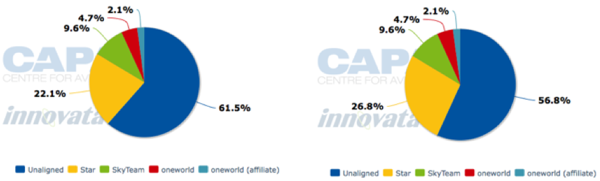
With Ethiopian formally joining, Star's share of total capacity in Africa has increased by nearly 5 percentage points, from 22.1% to 26.8%. Star is by far the largest alliance in the region.

SkyTeam now accounts for 9.6% capacity in Africa thanks largely to local member Kenya Airways as well as the African networks of Air France, KLM and Delta Air Lines. oneworld (including oneworld affiliates) has just 6.8% of the total capacity in Africa, making it the least represented of the three global alliances.

oneworld is only represented locally in Africa by Comair, which operates a British Airways franchise in South Africa. Unaligned carriers still account for 56.8% of capacity in Africa, a high figure compared to other regions.

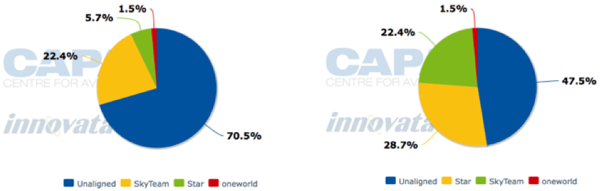
The impact of Ethiopian’s Star membership is biggest in East Africa. Star has now taken over from SkyTeam as the largest alliance in East Africa, increasing its share of capacity from 5.7% to 28.7%. SkyTeam has 22.4% of the capacity in the region followed by oneworld, with only 1.5%.

Africa: The Continent of the Future
Star Alliance CEO Jaan Albrecht said adding Ethiopian represents “a large step forward in completing our Africa strategy”. He said with three big hubs in Africa, Star has succeeded in its task to create an efficient travel system for all of Africa and “bring Africa to the world”.

Star Alliance now has three main bases in Africa - Johannesburg OR Tambo International Airport (through SAA), Cairo International Airport (through EgyptAir) and Addis Ababa Bole Airport (the home of Ethiopian Airlines). The addition of Ethiopian and the Addis Ababa hub means Star carriers now serve Africa with over 750 daily flights to over 110 destinations in 48 countries.

Mr Albrecht says offering a wider choice of flights to, from and within Africa than other alliances is particularly important because Africa is “a region of the world in which air travel is enjoying steady growth rates”. He called Africa “the continent of the future”.

Star Alliance CEO Jaan Albrecht said adding Ethiopian represents “a large step forward in completing our Africa strategy”. He said with three big hubs in Africa, Star has succeeded in its task to create an efficient travel system for all of Africa and “bring Africa to the world”.

Star Alliance now has three main bases in Africa - Johannesburg OR Tambo International Airport (through SAA), Cairo International Airport (through EgyptAir) and Addis Ababa Bole Airport (the home of Ethiopian Airlines). The addition of Ethiopian and the Addis Ababa hub means Star carriers now serve Africa with over 750 daily flights to over 110 destinations in 48 countries.

Mr Albrecht says offering a wider choice of flights to, from and within Africa than other alliances is particularly important because Africa is “a region of the world in which air travel is enjoying steady growth rates”. He called Africa “the continent of the future”.

ASKY likely to join Ethiopian in Star

Speaking to CAPA after the 13-Dec-2011 joining ceremony in Addis Abba, Mr Albrecht says Star does not see a need to add a fourth African member. Instead the alliance’s recruitment efforts are now focused on Russia, India and China. Star is still not represented in Russia or India, two important growth markets. In China Mr Albrecht believes new members beyond Air China and incoming member Shenzhen Airlines would be beneficial.

Mr Albrecht acknowledges Star is still relatively weak in West Africa but believes Ethiopian can fill this void. Ethiopian already serves several destinations in West Africa and has ambitious plans to grow ASKY, a Togo-based subsidiary which launched services at the beginning of last year. According to Innovata data, ASKY already serves 18 destinations, primarily in West Africa.

Mr Albrecht, whose decade-long tenure as Star CEO ends later this week as he has already started a new job as CEO of Austrian Airlines, says the alliance has not yet considered adding ASKY as a member. But as ASKY grows adding Sky would “make sense”.

Otherwise, West Africa lacks suitable candidates that meet Star’s standards. Mr Albrecht says Star was impressed with Ethiopian’s high standards, including its training and maintenance standards, and expects Ethiopian will bring those standards to West Africa with ASKY.

Star to help Ethiopian pursue rapid and profitable growth

Ethiopian Airlines hopes its Star Alliance membership will significantly boost its hub’s role as a prominent African gateway, boosting revenues, reputation and presence.

Speaking at Ethiopian’s joining ceremony, Ethiopian CEO Tewolde Gebremariam said joining Star is an important pillar to its 15-year business plan, known as Vision 2025. He says Star specifically will help Ethiopian implement its cost savings initiative and advance its multi-hub strategy in Africa, paving the way for “fast, profitable and sustainable growth”.

Ethiopian is already one of the world’s fastest growing carriers and plans to pursue further rapid growth, driven partially by its membership in Star, over the next 14 years. Mr Gebremariam says by 2025 Ethiopian plans to generate revenues of USD10 billion, across seven business groups, and carry 18 million passengers. The carrier expects to have 120 aircraft in service by 2025 and a network of 90 international destinations.
Ethiopian currently operates a fleet of 47 aircraft and a passenger network of 62 international destinations, including 40 within Africa. The 47 aircraft include six freighters which are used to operate dedicated freighter service to 24 destinations, including 15 in Africa. Ethiopian plans to continue to pursue rapid growth of its cargo business and is planning an expansion of its cargo terminal in Addis Abba. Ethiopian is also planning to expand its maintenance and training facilities as well as build a new headquarters over the next several years.

Ethiopian needs to order about 60 additional aircraft to meet growth plan

As Ethiopian only has 32 aircraft on firm order (include 12 A350s, 10 787s and eight 737-800s) and plans to replace about 20 of its current aircraft over the next decade, additional orders for approximately 60 aircraft are needed to meet its Vision 2025. As CAPA reported earlier this week, Ethiopian is now looking to exercise several options for 787s. Ethiopian will become Africa’s first 787 operator in 2Q2012 and will use the new type partially to expand its Asian network, where it sees huge opportunity for growth.
See related article: Ethiopian eyes 787 service to Hong Kong and new Asian services as Africa-Asia market booms.

While Ethiopian plans to add several new destinations, particularly in Africa and Asia, it will use Star partners to help expand its offline network. Ethiopian already codeshares with 17 carriers, 10 of which are also in Star – BMI, Brussels Airlines, Lufthansa, SAS, SAA, Turkish, Air China, Asiana, EgyptAir and SIA. Ethiopian plans to expand its codeshare partnerships with several of these carriers as well as implement new codeshares with some of the nearly 20 Star carriers it currently does not codeshare with.

Star increases presence in Ethiopia by over 19 fold

Addis Ababa is now served by only three other Star members - EgyptAir, Lufthansa and Turkish. By joining Star Alliance, Ethiopian has increased Star's capacity share in Ethiopia by over 19 fold, from 4.5% to 88.5%.
The second largest alliance in Ethiopia is now SkyTeam (2.0%) although unaligned carriers make up the country’s second largest capacity share. The SkyTeam alliance is represented by Kenya Airways, who serves Addis Ababa with approximately 2,000 seats per week. oneworld does not have any service to Ethiopia.

Ethiopia total capacity, seats share by alliance: before and after Ethiopian's Star membership
Addis Ababa BoleAirport total capacity, seats share by alliance: before and after Ethiopian's Star membership

Ethiopian Airlines currently operates approximately 115,000 seats per week at Addis Ababa, accounting for 83% of total capacity at the airport. Emirates, the second largest carrier, offers just 7,220 seats per week.
Addis Ababa Bole Airport capacity, seats per week, by carrier: 12-Dec-2011 to 18-Dec-2011
Ethiopia has very low LCC penetration, with just 0.8% of total capacity being held by an LCC (in this case, FlyDubai). Liberalisation has always been a contentious issue across the African continent including in Ethiopia. Ethiopian Airlines, because of its recent financial success and membershiop in Star, is in good position to meet any challenges future liberalisation may bring if the Ethiopian Government is willing to open Ethiopia’s sky to more international operators.

Ethiopian Airlines’ network is a valuable addition to Star Alliance as it serves many of the mineral-rich African countries such as the Democratic Republic of the Congo (gold and diamonds), Botswana (diamonds), South Africa (iron and oil), Namibia (via codeshare- lead, zinc, diamonds) and Angola (oil). It also serves Rwanda, Uganda, Tanzania and Nigeria – some of Africa’s fastest growing economies.

Ethiopian has a dedicated freight network like no other in Africa. Overall Ethiopian's African network is one of the most developed in Africa and is extremely valuable to Star, especially as air traffic on the continent is expected to increase in the years to come.

Its network does however have some limitations. Ethiopian’s coverage of Northern Africa is weak, which, luckily for Star, is already well covered by EgyptAir.

Important destinations missing from Ethiopian’s African network include Libya, Morocco, Tunisia and Algeria. EgyptAir serves all these destinations but has a weaker East and West African network. Therefore the Ethiopian and EgyptAir networks are highly complimentery. There is only small amount of cross-over between Ethiopian Airlines and EgyptAir’s networks, with both carriers serving Dubai, Khartoum, Nairobi, Jeddah, Abu Dhabi and Lagos. Together, Ethiopian Airlines and EgyptAir have Africa covered for Star.

Ethiopian Airlines African route map
Background information
Star Alliance, the largest of the three major alliances, now has 28 members. This will grow to 30 in 2Q2012, when Copa and Avianca-TACA are added as new members. Shenzhen is slated to become Star's 31st member in late 2012.

Global Alliances members
Oneworld
SkyTeam
Star Alliance
American Airlines
British Airways
Cathay Pacific
Finnair
Iberia
Japan Airlines
LAN
Malev Hungarian Airlines
Qantas
Royal Jordanian
S7 Airlines
Aeroflot
Aeromexico
Air Europa
Air France
Alitalia
China Airlines
China Eastern Airlines
China Southern Airlines
CSA Czech Airlines
Delta Air Lines
Kenya Airways
KLM Royal Dutch Airlines
Korean Air
Shanghai Airlines
Tarom
Vietnam Airlines
Adria Airways
Aegean Airlines
Air Canada
Air China
Air New Zealand
ANA
Asiana Airlines
Austrian Airlines
Blue1
bmi
Brussels Airlines
Continental Airlines
Croatia Airlines
EgyptAir
Ethiopian Airlines
LOT Polish Airlines
Lufthansa
Scandinavian Airlines
Singapore Airlines
South African Airways
Spanair
SWISS
TAM Airlines
TAP Portugal
Thai Airways
Turkish Airlines
United Airlines
US Airways
Pending Members
   
Air Berlin
Kingfisher Airlines
Malaysia Airlines
Aerolineas Argentinas
Garuda Indonesia
Middle East Airlines
Saudi Arabian Airlines
Aerolineas Argentinas
Xiamen Airlines
Avianca-TACA
Copa Airlines
Shenzhen Airlines


Article Courtesy: Centre for Asia Pacific Aviation

Email Us at FlightAfricablog@gmail.com

Ethiopian to use B787 Dreamliner in the Hong Kong and new Asian services as Africa-Asia market booms

Article Courtesy: Centre for Asia-Pacific Aviation
Ethiopian will become the first carrier in Africa and Europe to operate 787s when it takes the delivery of its first 787-8 in 2Q2012.

Ethiopian Airlines will further strengthen itself in the nascent but rapidly growing Africa-Asia market by using its new Boeing 787 Dreamliners to open new routes – potentially in China, Malaysia and Singapore – reduce costs and align its overall fleet strategy to better serve existing Asian destinations. The geography of Ethiopian's hub in Addis Ababa allows the carrier to offer as efficient or more efficient connections than those through Middle East hubs. Ethiopian's African network is also unrivaled in the number of destinations served, and the booming times are seeing Ethiopian consider exercising 787 options and accelerating deliveries, slots permitting. Elsewhere in its route network, whose capacity is growing at 30% a year, Ethiopian next year will commence services to Toronto and in 2013 will increase capacity to Washington Dulles by deploying 777-300ERs.

Ethiopian will become the first carrier in Africa and Europe to operate 787s when it takes the delivery of its first 787-8 in 2Q2012.
The 787 last week made its African debut, with a demonstration aircraft in Addis Abba that coincided with a ceremony celebrating Ethiopian joining the Star Alliance.

Ethiopian had planned to first deploy its 787 – most previously expected in Jan-2012 – to Guangzhou, as CAPA reported in Jun-2011. Ethiopian CEO Tewolde Gebremariam told CAPA yesterday that Guangzhou is still an option for the carrier’s first 787 but Ethiopian is also now looking at using its first 787 to serve Hong Kong. He says Ethiopian is also evaluating three potential Asian routes which could be launched with the 787: Chongqing in China, Kuala Lumpur in Malaysia and Singapore.

787 better suited to Hong Kong's lower demand

Guangzhou may not end up receiving Ethiopian's 787 on a regular basis because demand is now so strong from Guangzhou a larger aircraft is needed. Guangzhou had been served daily via Bangkok with 767-300ERs and the intention was to upgrade the route to non-stop once the first 787 was delivered. But Mr Gebremariam said Ethiopian decided to instead upgrade Guangzhou in Oct-2011 to non-stop using the 777-200LR, which seats 321 in two classes. Ethiopian's 767-300ER typically seats 234 while its 787-8 will seat 270 (24 in business and 246 in economy), giving the 777-200LR a 50 seat advantage – as well as greater cargo capacity, critical on the route to Guangzhou, China's manufacturing heartland.

Ethiopian has seen higher demand from mainland China than Hong Kong.
Mr Gebremariam says Guangzhou is switching back this week to the 767 via Bangkok but says demand is generally sufficient to support the 777-200LR. While Guangzhou could still see the 787 instead of the 777-200LR during certain times of the year, Mr Gebremariam foresees the 787 used more regularly to Hong Kong because Ethiopian has seen higher demand from mainland China than Hong Kong.

Ethiopian now serves Hong Kong with four weekly 767-300ER flights via Bangkok. Mr Gebremariam says these will be upgraded to non-stop, likely in 2Q2012, after the first 787 is delivered.
Africa-East Asia routes currently operated or planned
Carrier Destination(s)
Air Austral Bangkok
Air Mauritius Bangalore, Chennai, Hong Kong, Kuala Lumpur, Mumbai, New Delhi, Shanghai, Singapore
Air Zimbabwe Beijing
Cathay Pacific Johannesburg
Ethiopian Beijing, Bangkok, Guangzhou, Hong Kong, Mumbai, New Delhi
Hainan Luanda
Jet Airways Johannesburg
Kenya Airways Bangkok, Guangzhou, Hong Kong, Mumbai
Malaysia Airlines Cape Town, Johannesburg
Singapore Airlines Cape Town, Johannesburg
TAAG Angola Airlines Beijing
Thai Airways Johannesburg
South African Airways Beijing (planned), Hong Kong, Mumbai

Four 787s in 2012 with further orders likely

Mr Gebremariam says Ethiopian is now slated to receive four 787s in 2012 with the first to be delivered in the April to June timeframe. Ethiopian currently has 10 787s on order. All are for the -8 variant with the last aircraft slated for delivery in 2014. Mr. Gebremariam says the carrier is interested in exercising options for additional 787s and accelerating its deliveries, although 787 production slots are tight. Ethiopian, which also has orders for 12 A350s and nine additional 737-800s, needs more aircraft to meet its 15-year business plan.
Mr Gebremariam says the 787 will enable Ethiopian to open new destinations while lowering its operating cost. “It is a pillar of our Vision 2025 [business plan],” he says.

Ethiopian is particularly bullish on using its 787s to expand in Asia although the type will also be used on some European routes, likely starting by the end of 2012. Ethiopian now serves three destinations in mainland China – Guangzhou, Beijing and Hangzhou – and is planning to add several Chinese cities as part of Vision 2025, likely starting with Chongqing. While new destinations in Southeast Asia and North Asia are also part of Vision 2025, China is particularly the focal point as traffic between China and Africa is expected to boom.

Consideration of Asian hub in Singapore

Ethiopian is particularly interested in Singapore. Mr Gebremariam acknowledges that Addis Ababa-Singapore is a small local market but sees potential for Singapore to become Ethiopian's Asian hub. Ethiopian Airlines and Singapore Airlines began a codeshare at the beginning of last month on the Addis Ababa-Dubai-Singapore route (with Ethiopian operating Addis Ababa-Dubai and Singapore operating Dubai-Singapore). This codeshare could potentially be expanded to include Singapore Airlines and SilkAir destinations in Southeast Asia as well as destinations in China, giving Ethiopian offline access to more of Asia.

Singapore Changi is also keen to attract an East African carrier given the opportunities a Singapore-East Asia route could have in developing Singapore as a hub for broader Asia-Africa connections. Currently Changi only has one African carrier, Air Mauritius, and Singapore Airlines only serves one African country, South Africa, non-stop from Singapore (Cairo is served via Dubai). Rival hub Bangkok has been far more successful at developing African connections and has service from several African carriers including Ethiopian and Kenya Airways. While Ethiopian is also considering Kuala Lumpur, Singapore makes more sense as Singapore is a Star hub. Bangkok is also a Star hub but Ethiopian does not yet have a codeshare with Thai Airways.

As CAPA reported in June of expected rapidly growing China-Africa links:
China is a key market for the carrier as Ethiopian is ideally positioned geographically to tap into the fast growing China-Africa market. Ethiopian currently operates 26 weekly flights to four destinations in China, making it the largest carrier between China and Africa. It has already begun codesharing with Star member Air China.
Over the past decade air traffic between Africa and Asia has doubled. Africa supplies China with one-third of its fuel needs as well as notable amounts (by value) of timber, copper and diamonds, with trade between Africa and China surpassing USD100 billion in 2010.

Annual number of inter-continental seats to/from Africa: 1988-2010

Of all traffic measured in revenue passenger kilometres to/from and within Asia-Pacific, Africa will have the highest annual growth rate at 8.4% through 2020, eclipsing the 7.5% of intra-Asia-Pacific traffic and 7.5% of Latin America-Asia-Pacific traffic, Airbus forecast in its 2011 market outlook.
Average annual growth of traffic to, from and within Asia-Pacific: 2011-2020

African travel will also eclipse the global average of traffic growth to/from and within Europe. RPKs from Africa will grow at 4.5% a year between 2011 and 2030, outpacing the 4.2% average, although Africa falls behind the Middle East, Russian Federation and Asia-Pacific.

Average annual growth of traffic to, from and within Europe: 2011-2030

Africa will account for the second-highest growth of traffic to/from and within North America, growing at 5.6% a year from 2011 to 2030.
Average annual growth of traffic to, from and within North America: 2011-2030

While Africa's growth rates are high, the growth is based off currently low figures. Travel to/from/within Africa will be the single smallest region, representing just 3% of 2030's RPKs by Airbus estimates.
Share of world air travel by RPKs: 2030 projection

Addis Ababa hubs provides strategic connections

Ethiopian's hub in Addis Ababa provides geographically convenient connections. On a sample routing from Shanghai to Johannesburg, transiting through Addis Ababa is only 21nm longer than transiting through Dubai.
Route comparison: Shanghai to Johannesburg via Dubai and Addis Ababa

Routing Distance (nm)
Shanghai-Dubai 3488
Dubai-Johannesburg 3450
Total distance via Dubai 6938
Shanghai-Addis Ababa 4773
Addis Abab-Johannesburg 2187
Total distance via Addis Ababa 6960
A routing from Guangzhou to Entebbe (Kampala) is 162nm shorter through Addis than Dubai.
Route comparison: Guangzhou to Entebbe via Dubai and Addis Ababa

Routing Distance (nm)
Guangzhou-Dubai 3152
Dubai-Entebbe 2010
Total distance via Dubai 5162
Guangzhou-Addis Ababa 4345
Addis Abab-Entebbe 655
Total distance via Addis Ababa 5000
While intermediate point connection distances matter (as well as connection flight timing, which Emirates excels at with three departure banks) so too do the destinations served on the other end. Ethiopian serves 40 points in Africa compared to Kenya Airways' 44, Emirates' 21, Qatar's 14 and Etihad's 11. South African Airways, although not as strong a competitor for Asia-Africa services, has flights to 31 destinations in Africa.

Beijing a borderline route for Ethiopian after 787 performance shortfall

Boeing sees the 787 as a vehicle to increase connectivity between China and Africa. Kenya Airways, which is one of four African customers for the 787 (the others are Arik Air and Royal Air Maroc), is also well positioned to tap in the booming China-Africa market.

Boeing sales director for Africa Rob Faye told CAPA following a press briefing yesterday in Addis Abba that the 787 in Africa will be used more for route development than replacing existing aircraft, pointing out that Ethiopian and Kenya are both planning to double their overall fleets over the next 10 years. The 787 demonstrator will be stopping in Kenya later this week as part of its multi-month world tour.

The 787 is geared as a 767 replacement, and Ethiopian's order of 10 787s corresponds to replacements for its 10 767-300s, but its comments to obtain additional frames support route growth. Likewise Kenya Airways has 5 767-300s in service and 9 787s on order.

“Africa is going to grow. Aviation is the catalyst to growth,” Mr Faye says, adding that without connectivity economic growth is limited.

Ethiopian is now unable to use its 767s to serve China non-stop because of the takeoff restrictions at Addis Abba, which has an altitude of over 7000ft. Hangzhou is served via Delhi and is another likely non-stop route for the 787. Ethiopian also previously served Beijing via Delhi but was able to upgrade its daily Beijing service to non-stop in May-2011 after taking delivery of its second batch of 777-200LRs.

Mr. Gebremariam says Ethiopian plans to continue using 777-200LRs on the Addis Abba-Beijing route rather than switch to 787s as he expects the carrier would have some payload limitations with the 787 to Beijing. Mr Gebremariam says Ethiopian would likely have to leave a few seats empty flying the 787 out of Addis Abba for Beijing and would also be restricted in carrying belly cargo.

Boeing, however, claims the 787-8 has the range to reach Beijing from Addis Abba, factoring in Addis Abba’s high altitude and normal 242-seat configuration. Ethiopian plans to operate its 787-8s with 246 seats in two-class configuration.

Even if Beijing ends up being a borderline route for operating the 787-8 with full payload, all of Ethiopian’s other Asian routes and all its European routes are safely within range with full payload. As a result, Mr Gebremariam does not seem to upset with the aircraft coming in with less range than originally expected.
...the range difference between the expected and actual range is very small...
Mr Gebrermariam says the range difference between the expected and actual range is very small with Beijing the only affected current route. He says Korea and Japan are also now out of range but while Korea and Japan are potential routes in the carrier's long-term business plan they are currently not high priorities.

Ethiopian originally intended to use its 787s to serve the US via Europe but later decided to order five 777-200LRs to help offset the impact of the delivery delays on the 787. The first batch of two 777-200LR were delivered at the end of last year and used to upgrade Washington Dulles, which is now served non-stop on the eastbound leg. The last three 777-200LRs from Ethiopian’s order were delivered this year and used to upgrade Beijing and Guangzhou. Ethiopian also uses the 777-200LR on one of its two daily Dubai flights.
Preliminary changes to Ethiopian Airlines long-haul route network
Route Status Equipment Remarks
Chongqing Under consideration 787-8
Europe, general Active
Future
767-300ER
787-8
Guangzhou Active 777-200LR alternating with 767-300ER 787 may replace 767 during select times
Hong Kong Active
Future
767-300ER via Bangkok
787 direct service
Likely first 787 destination
Kuala Lumpur Under consideration 787-8
Singapore Under consideration 787-8
Toronto Future 777-200LR
Washington Dullles Active
Future
777-200LR
777-300ER

Toronto to be launched in 2012

Ethiopian was planning to begin flights this quarter to Toronto with 777-200LRs but postponed the launch of the new route. Mr Gebrermariam says Toronto is now planned to be launched in summer 2012 with two or three weekly 777-200LR flights. Like Washington DC, Toronto will be served non-stop on the eastbound leg but will stop in Rome going west.

Ethiopian is continuing to study other potential new destinations in North America. But for now the carrier plans to focus on Washington Dulles and Toronto. Both are Star Alliance hubs which will help Ethiopian connect with the rest of North America.

Ethiopian does not plan to acquire additional 777-200LRs but Mr Gebrermariam says the carrier has committed to acquiring two 777-300ERs for delivery in 2013. He says the intention is to use the 777-300ERs to up-gauge the Washington Dulles route.

The 777-300ER has the range to be able to operate non-stop from Dulles to Addis Abba. Westbound a fuel stop will still be required but this is no disadvantage to the longer-range 777-200LR, which also needs a stop going west because of Addis Abba’s high altitude. Mr Gebrermariam says Ethiopian will keep its 777-200LRs even as the Dulles route switches over to 777-300ERs as it still has routes which are too thin for 777-300ERs and are too long for the 787.

Overall Ethiopian is a flexible carrier and will likely change multiple times its deployment of aircraft. The main focus is rapid growth and to secure as many modern widebodies as possible.

Mr Gebrermariam laments the 787s are still not coming fast enough, forcing the carrier to stick with some of its ageing 767-300ERs for longer than it wishes. He says Ethiopian this month returned one of its 767-300ERs, which leaves it with 10 of the type. But he said Ethiopian is unable to phase out any of its 767s in 2012 as it aims to continue growing capacity at a clip of 30% per year.

Ethiopian, however, is phasing out three of its seven 757s in 1H2012. Mr Gebrermariam says the 757s will be replaced by a mix of additional 737s, 787s and 767s. Ethiopian is not increasing its 767 fleet but some 767s will be freed up to replace 757s on routes to Europe and within Africa as 787s replace 767s on Asian routes.


Email Us at FlightAfricablog@gmail.com

Ethiopian Airlines: The new spirit of Africa looks to become a rising star.


Ethiopian CEO Tewolde GebreMariam
TODAY ONE OF THE LARGEST AND MOST PROFITABLE AIRLINES IN AFRICA, Ethiopian Airlines launched its first commercial service on 08-Apr-1964 – a Douglas C-47 Skytrain, which travelled to Cairo via Eritrea’s Asmara. The airline, a joint venture between the Ethiopian Government and Trans World Airlines, experienced gradual and steady growth right up until early this century – when it decided to surge forward and make a name for itself as a significant worldwide player. 

With 34 aircraft on order, including 10 B787-8s, a network of 56 international destinations, 16 codeshare partners, Star Alliance membership to its name and a 2010 operating profit of ETB1.6 billion (USD92 million), Ethiopian has forged a successful path for its expansion plans and has come a long way since its humble beginnings. The airline’s ambitious, but probably realistic, 15-year strategic plan includes becoming the largest airline in Africa, generating revenues of ETB171 billion per year, acquiring a fleet of 70 aircraft and obtaining a Skytrax customer service ranking increase from three to four stars.

The African launch customer for the B787-8 made its order in 2006 and originally planned to have the aircraft in service by Jun-2010 on the Guangzhou route. However, like many of Boeing’s B787 customers, the Dreamliner delays have left Ethiopian behind on expansion plans.

In 2010, Ethiopian placed its largest order to date – 12 A350-900s, due for delivery between 2016 and 2019. The order was designed to give Boeing a wake-up call – implying that its long-time African operator was unhappy with the delays, and that it was prepared to look elsewhere for new aircraft. Despite the apparent threat, Ethiopian Airlines reaffirmed its Boeing order and is expecting its first B787-8 between 12-Mar-2012 and 15-Jun-2014. Ethiopian stated the new aircraft, both the B787-8s and the A350-900s, will be used to complement and replace its existing fleet, with the A350s to be deployed on services to the Far East and the Americas, and the B787-8s likely to replace B767s and B757s.

Ethiopian was scheduled to join Star Alliance in early Nov-2011. Ethiopian, mentored by Lufthansa, joined fellow African Star Alliance members South African Airways and EgyptAir, as the alliance extends its coverage to all but the west and centre of the continent. In the lead-up to the approval, Ethiopian Airlines established codeshare agreements with several key Star Alliance members, the latest being Asiana Airlines, and the most important being founding members SAS and Lufthansa.


Ethiopian’s entry into Star Alliance means the global airline group now has three main bases in Africa – Addis Ababa, Johannesburg and Cairo. Ethiopian hopes Star Alliance membership will significantly boost Addis Ababa International Airport’s role as a prominent African gateway, boosting revenues, reputation and presence.

SkyTeam occupies a relatively strong presence in Africa through Air France-KLM and Kenya Airways. Air France and KLM have each built networks on the continent based around their longstanding colonial linkages. While leading Star member Lufthansa does not have the same historical ties as Air France and KLM, it does have fellow alliance members in the north, south and now the east of the country. Star made a point of recruiting strategic partners that spread across the continent, to complement the more than 50% of Star members that operate to Africa.

Within Star, EgyptAir provides a most challenging partner. Both EgyptAir and Ethiopian serve a handful of destinations in the Asia Pacific including Beijing, Guangzhou, Bangkok and Mumbai, aiming to feed in traffic from the African continent. Star will benefit from Ethiopian’s African network as it is more established than the Egyptian flag carrier, particularly in West Africa, while EgyptAir is much stronger in North Africa. Each carrier serves points in the Middle East – Kuwait, Bahrain, Riyadh, Beirut, Tel Aviv, Jeddah, Sana’a and Muscat – creating considerable overlap in Star’s Middle Eastern network and, again, in their respective goals for feeding beyond traffic from Africa.

Ethiopian serves many of the mineral-rich African countries, offering valuable additions to Star’s network. These include the Democratic Republic of the Congo (gold and diamonds), Namibia (via codeshare – lead, zinc, diamonds), Botswana (diamonds) and South Africa (iron, oil). Ethiopian also serves fast growing African economies, such as Rwanda, Ghana, Angola, Kenya and Nigeria.

A sub-region missing from Ethiopian’s network is northern Africa, where it offers service only to Cairo – already well covered by EgyptAir. Important gaps in its network include the oil- and iron-rich countries of Libya and Morocco in North Africa, each better covered by EgyptAir – which serves one destination each in Morocco, Tunisia, Algeria and two in Libya – with the natural advantage of serving multiple destinations within Egypt. But together Ethiopian and EgyptAir have Africa covered for Star.

Ethiopian was the first foreign airline to operate into China more than 30 years ago. At that time a political link, it has proven a valuable and longstanding connection into the Asian powerhouse. Times have changed however; though Ethiopian may have been safe from competition 30 years ago, this is no longer the case and Middle Eastern carriers are rapidly expanding alternative links between the region’s oil- and mineral-rich countries and China. Eight Middle Eastern carriers now operate between China and the Middle East including Emirates, Qatar Airways, Etihad, El Al, Mahan Airlines, Saudi Arabian Airlines, Yemen Airways and Iran Air.
Only two airlines operate third and fourth freedom services between Eastern Africa and China – Ethiopian Airlines and Air Mauritius – offering approximately 9500 seats per week combined. Emirates, however, offers considerably more than 12,000 seats per week from Dubai to China, with numerous connections on to the Middle Kingdom, which is three times more than Ethiopian’s offering to China. Middle Eastern carriers provide a convenient, one-stop link between multiple points in both Africa and China that rivals the offering of many African carriers, with their multiple stops and limited capacity and frequency.

The Gulf airlines are also achieving major capacity share on routes to Europe. While a similar number of airlines operate Middle East-China and East Africa-China, the importance lies in the number of seats on offer. Emirates, the second largest carrier to operate between Africa and Europe, offers more than 88,000 seats per week, while Air France, the largest carrier to operate between Europe and East Africa, offers just 7000.
Despite the competition coming from the northeast, Ethiopian Airlines’ most direct source of competition is found closer to home, by way of SkyTeam member Kenya Airways. Kenya’s flag carrier is another leading African carrier with aggressive expansion plans. The airline aims to serve “every African country by 2013” and is making steady progress towards that goal, including a rights issue scheduled for Nov-2011 designed to give the carrier a major cash injection. Kenya Airways’ operating profit surged in FY2011, up 73.9% from a dismal 2010 result, suggesting the carrier is back on track to achieve profitability.

A strong point in Ethiopian Airlines’ portfolio is its substantial freight operation, with a dedicated cargo fleet of five aircraft and four B777-200LRFs on order. Cargo and freight services accounted for 17% of its total 2010 revenue. The carrier serves more than 40 destinations in its freight network through dedicated freighters and belly space on passenger aircraft. In 2009, Ethiopia’s export in goods was worth ETB28 million, the same as 2008’s levels but still well up on 2007’s ETB20.7 billion.

So what is Ethiopia’s secret in being able to support one of the few profitable airlines in Africa? One significant factor is the national airline’s major capacity share at its home in Addis Ababa, thanks largely to the Ethiopian Government’s restrictions on foreign airline access. Ethiopian Airlines also holds a near-monopoly on domestic routes, where it competes with just one other Ethiopian-registered carrier, Trans Nation Airways, which has one aircraft in service and none on order.

Ethiopia has proven one of the least LCC-friendly markets. Full service carriers account for no less than 99% of capacity at the airport, with flydubai the only LCC to operate into Ethiopia, operating a three-times weekly B737-800 service from Dubai.

Here, protective policies do little to help Addis Ababa’s aspirations to become a large hub, so its future remains inextricably linked to the flag carrier’s growth plans. The result is, paradoxically, to make Ethiopian more exposed to competition from the Gulf carriers’ services into Ethiopia and other African ports. As long as Ethiopian shoulders all of the hub development, so the airport’s attraction limits the flag carrier’s potential to on-carry traffic from other airlines.

Ethiopian Airlines has been consistently profitable over the past four years and is likely to see future profitability as its expansion plans are rolled out. Freight, although sensitive to market fluctuations, remains a strong point. Ethiopian has experienced considerable success with its network and sees it as a future revenue generator. Now, armed with a Star Alliance membership that gives it access to even more destinations worldwide, there may be no stopping the “new spirit of Africa”.

Liberalisation must surely spread across Africa, but Ethiopian – more than almost any other airline in the region – has the opportunity to restructure in time to meet the new challenges this brings. So long as it continues to expand rapidly, this revitalisation process will be made easier – provided it is addressed as a key priority. Expansion alone will not suffice.

 Article republished  from Airline Leader Magazine
Email Us at FlightAfricablog@gmail.com

The Sahara: Ethiopian Airlines takes delivery of 5th Boeing 777-200LR

Ethiopian Airlines has taken delivery of its 5th Boeing 777-200LR. Named The Sahara, the brand new 777-200LR arrived at the Addis Ababa Bole International Airport late last week.

Ethiopian Airlines has named its five Boeing 777-200LRs with African land marks highlighting the theme of “The New Spirit of Africa”. Accordingly, the first 777-200LR named, “The Blue Nile”, the second “Rift Valley” , the third “Victoria Falls”, the fourth “Mount Kilimanjaro and the fifth “The Sahara”.